
Capital gains tax on a cash home sale works exactly the same way it works on a financed sale. Selling a house for cash raises a question almost every homeowner asks: does getting paid in cash change what you owe the IRS? The short answer is no, the payment method has nothing to do with your capital gains bill. What matters is how much profit you made on the sale, how long you owned the property, and whether you lived in it as your primary residence. This guide walks through the basics so you can go into a cash sale with a clear picture, not a guess.
This is general information, not tax advice. Every homeowner’s situation is different, and a licensed CPA or tax attorney is the only person who can tell you exactly what you owe. What we can do, based on years of buying houses directly from homeowners in a wide range of financial and personal situations, is explain how the tax question actually works so you know what to ask your accountant.
Capital Gains Tax Has Nothing to Do With Cash vs. Financing
A lot of sellers assume that a cash sale is treated differently by the IRS than a sale where the buyer uses a mortgage. It is not. The IRS calculates capital gains tax on the profit from the sale of an asset, in this case a house, regardless of how the buyer paid for it. Whether the money comes from a bank loan, a wire transfer from an investor, or a stack of hundred dollar bills, the tax treatment is identical.
What actually determines your tax liability is:
- Your sale price minus your adjusted cost basis (what you paid, plus qualifying improvements, minus depreciation if applicable)
- How long you owned the property (short-term vs. long-term capital gains)
- Whether the home was your primary residence and for how long
- Your overall income and filing status, which affects your capital gains tax rate
None of those factors change because the buyer paid in cash. If you are comparing a fast cash sale to a traditional listing, the cash vs. agent calculator can help you see the full financial picture side by side, including what typically gets deducted from each type of sale, so you are not caught off guard at closing.
The Primary Residence Exclusion Is the Biggest Factor for Most Sellers
For most homeowners selling their main house, the primary residence capital gains exclusion is the single most important rule to understand. Under current IRS guidelines, if you owned and lived in the home as your primary residence for at least two of the five years before the sale, you can typically exclude up to $250,000 of profit from capital gains tax, or up to $500,000 if you file a joint return with your spouse [IRS Topic No. 701, verified 2026-09-20].
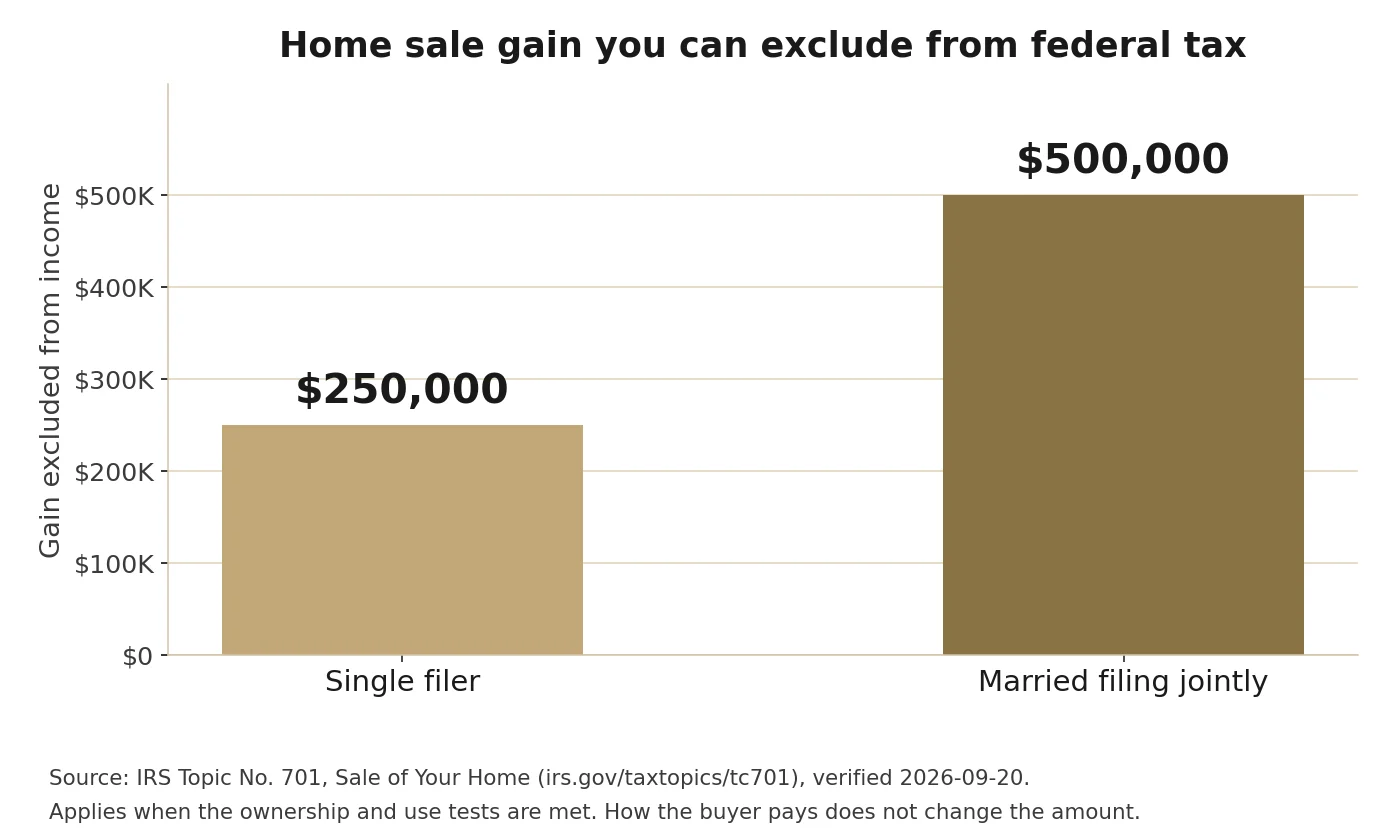
This exclusion applies whether you sell to a traditional buyer with financing or to a cash buyer. It is tied to how you used the property, not how the transaction closed. The IRS has detailed guidance on this exclusion, including the ownership and use tests, on its official site: IRS Topic No. 701, Sale of Your Home.
If the house you are selling was not your primary residence, such as an inherited property, a rental, or a second home, this exclusion generally does not apply and the full gain may be taxable. That is a common situation for people who sell inherited houses quickly for cash rather than deal with repairs, tenants, or a long listing process.
Short-Term vs. Long-Term Gains Change Your Rate
How long you have owned the property matters a great deal for tax purposes. The IRS treats an asset you held for one year or less as a short-term capital gain and taxes it at your ordinary income tax rate. An asset you held longer than one year typically qualifies for long-term capital gains rates, which run lower.
This distinction matters for people who buy a fixer-upper, flip it quickly, or inherit a property and sell soon after. If you are weighing whether to hold a property a little longer versus selling now for cash, the holding period is one of the variables your tax preparer will want to know. It is a good reason to talk to a tax professional before you sign anything, not after.
Special Situations: Inherited Homes, Condemned Property, and Divorce Sales
Not every cash sale looks like a straightforward homeowner deciding to move. Several common situations change how the IRS calculates your gain:
- Inherited property: Heirs generally receive a “stepped-up basis,” meaning the home’s cost basis resets to its fair market value at the date of the original owner’s death. This often reduces or eliminates taxable gain if the home is sold soon after inheriting it.
- Condemned or unsafe property: Homes that are structurally unsound, fire-damaged, or facing code enforcement action still count as capital assets, and the same gain calculation applies. If you are dealing with a property in this condition, our guide on how cash buyers provide a lifeline for condemned or unsafe property explains how a sale can move forward even when a home cannot be financed conventionally.
- Divorce-related sales: Special rules can apply when a home is sold as part of a divorce settlement, including how the exclusion is split between spouses.
Each of these scenarios has its own wrinkles, and none of them are resolved by the fact that the sale happens quickly or for cash. They are resolved by tax law, ownership records, and documentation, which is exactly why a tax professional should be part of the conversation.
Why Sellers Confuse a Fast Sale With a Tax Shortcut
It is easy to see why the confusion exists. Cash sales close faster, skip appraisals and financing contingencies, and often involve fewer people in the transaction. That simplicity can feel like it should extend to taxes too, but the IRS does not treat a fast closing any differently than a 45-day closing with a mortgage lender involved. The title company files the same 1099-S form reporting the sale to the IRS regardless of how the buyer funded the purchase.
Where a cash sale genuinely can help your bottom line is in reducing the costs that eat into your proceeds before taxes are even calculated. No realtor commissions, no repair credits negotiated by a buyer’s inspector, and no months of carrying costs while a home sits on the market. Lower selling costs can mean a larger net amount in your pocket, which is a real financial benefit, just not a tax exemption.
Documentation You Will Need Regardless of How You Sell
Whether you sell through a traditional listing or accept a cash offer, you will want to have the following on hand when you talk to your tax preparer:
- The closing statement (settlement statement) from the sale
- Records of the original purchase price
- Receipts or records for capital improvements made over the years (a new roof, an addition, major system replacements)
- Records of any depreciation taken, if the property was ever used as a rental
- Proof of primary residence, such as utility bills or your driver’s license address, if you are claiming the exclusion
Keeping this paperwork organized before you sell makes the whole process smoother, whether you are working with a title company or a tax preparer. If you are trying to verify that the company making you a cash offer is legitimate before you get to the closing table, our guide on how to spot a legitimate cash home buyer is a good place to start.
Our Experience Working With Sellers on Tax-Sensitive Sales
ROI National is a family-owned cash home buyer based in Southampton, Pennsylvania, buying houses across Pennsylvania, New Jersey, and Delaware since 2015 (about ROI National). We have worked with homeowners across a wide range of circumstances: people relocating for a new job, families settling an estate, owners dealing with a condemned or fire-damaged property, and sellers who simply want to skip the listing process. Along the way, tax timing comes up constantly, because sellers want to know how a sale fits into their overall financial picture before they commit. We are not tax advisors and we do not prepare returns, but we have seen enough closings to know which documents sellers need and which questions they should be asking their CPA before signing a purchase agreement. That experience shapes how we walk sellers through a transaction: clearly, honestly, and without pretending to know things outside our lane.
How a Cash Sale Can Still Simplify Your Financial Picture
Even though a cash sale does not change your capital gains liability, it can simplify the process of figuring out your net proceeds. There are no last-minute negotiations over repairs, no financing falling through after weeks under contract, and no uncertainty about whether the deal will actually close. That predictability matters if you are trying to plan for a tax bill, coordinate a move, or settle an estate on a timeline.
If you are upgrading to a new home and trying to time your sale around a purchase, our article on why selling your old house for cash makes sense when upgrading covers how a fast, certain closing date can make the whole move easier to coordinate. And if you are located in the Philadelphia area and want to understand how a quick sale process typically works from offer to closing, take a look at our page on the Philadelphia quick home sale process.
Local Considerations for Homeowners in the Region
Property tax records, transfer taxes, and local recording fees vary by county and municipality, and those local costs are separate from federal capital gains tax. If you are considering a cash sale in Bucks County or the surrounding area, our page for cash home buyers near Southampton, PA outlines how the local process typically works. Local transfer taxes and recording fees will show up on your closing statement regardless of who buys the home, so it is worth reviewing that document closely with your tax preparer alongside your federal capital gains question.
Frequently Asked Questions
Does selling my house for cash mean I avoid capital gains tax?
No. Capital gains tax is based on your profit from the sale, your ownership history, and whether the home was your primary residence, not on how the buyer paid. A cash sale is taxed the same way as a financed sale.
Will I owe taxes if I sell my primary residence for cash?
If you owned and lived in the home as your primary residence for at least two of the last five years, you may be able to exclude up to $250,000 of the gain, or up to $500,000 filing jointly with your spouse [IRS Topic No. 701, verified 2026-09-20]. This applies to cash sales the same as any other sale. Talk to a tax professional to confirm how the ownership and use tests apply to you.
What if I inherited the house I’m selling for cash?
The IRS gives an inherited home a stepped-up cost basis equal to its fair market value at the time of the original owner’s death. This often reduces or eliminates taxable gain, especially if the home is sold relatively soon after inheriting it. A tax professional can confirm the exact basis and any gain based on your specific situation.
Does a fast closing change how the sale is reported to the IRS?
No. The closing or title company reports the sale on a 1099-S form regardless of how quickly the transaction closes or how the buyer funded the purchase.
Who should I talk to about my specific tax situation before selling?
A licensed CPA or tax attorney is the right resource for calculating your specific capital gains exposure. They can review your purchase price, improvements, depreciation history, and residency timeline to give you an accurate answer before you sell.
If you are weighing a cash sale and want a clear look at your options, get in touch with us. Our how it works page lays out each step from offer to closing. We can walk you through how the process works, answer questions about timing and paperwork, and help you decide if a fast cash sale fits your situation. Your capital gains tax on a cash sale stays exactly where it belongs, with you and your own CPA.