
When a cash home buyer sends over an offer, the first question most sellers ask is simple: which closing costs come out of a cash offer, and how much of that number do I actually keep? Sellers who have only sold through a listing agent are used to a long list of deductions between the sale price and the check. A cash offer is structured differently, and knowing exactly what can and cannot come out of it protects you from signing something you did not fully read.
This guide covers the typical closing costs on a home sale, which ones a cash buyer usually absorbs, the Pennsylvania realty transfer tax that most sellers overlook, and the debts tied to the property that get paid off at closing no matter who buys it.
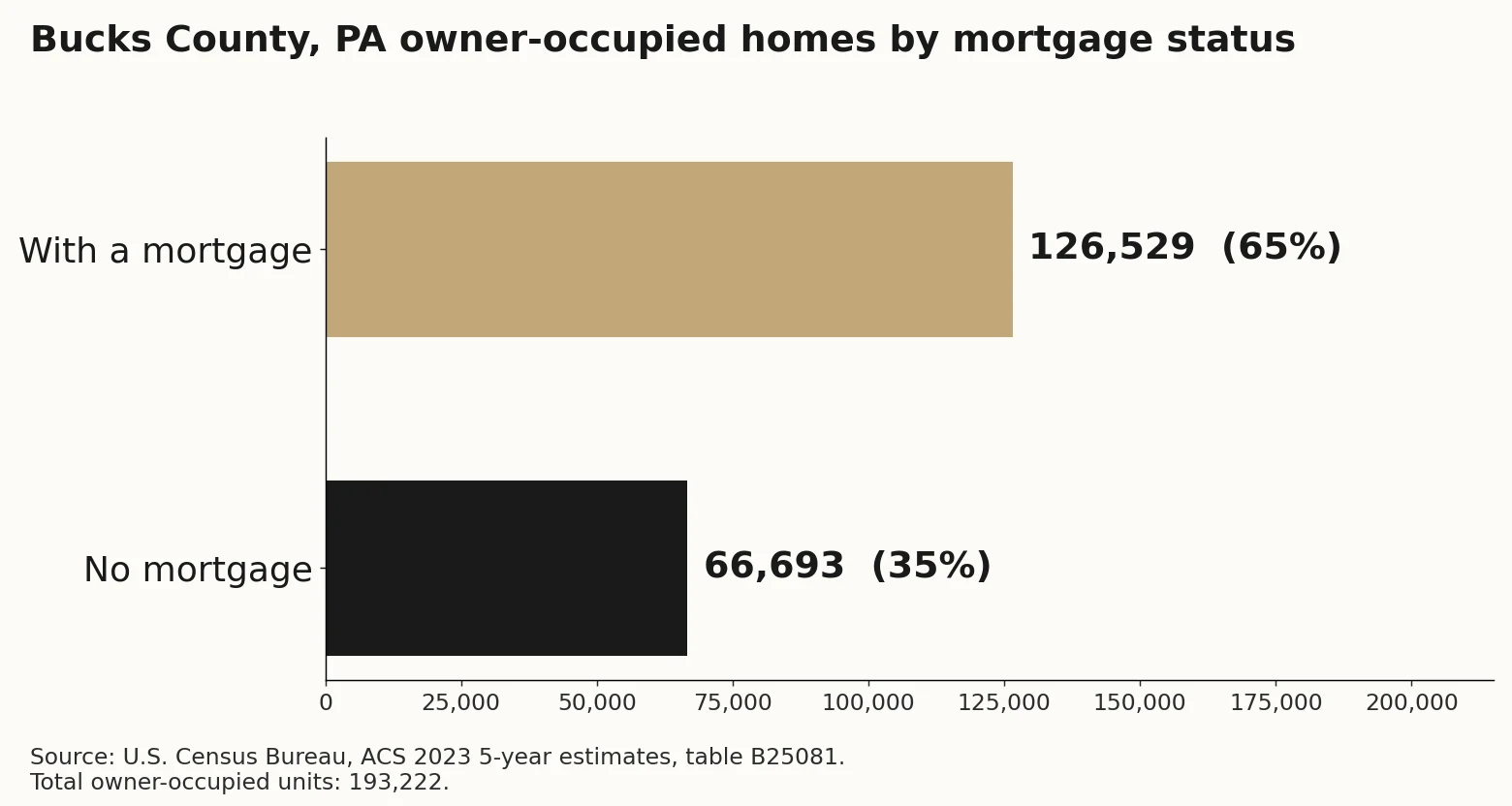
That chart matters for one reason. In Bucks County, 126,529 of 193,222 owner-occupied homes, about 65 percent, still carry a mortgage according to the Census Bureau. For most sellers, the mortgage payoff is the largest amount that leaves the closing table, and it leaves whether the buyer pays cash or borrows. Closing costs are a separate question, and that is where a cash sale changes the math.
How a Cash Offer Differs From a Traditional Sale Price
In a traditional sale with a listing agent and a financed buyer, the price on the contract is not what the seller takes home. Agent commission, seller closing costs, buyer concessions, repair credits after the inspection and lender-required fixes all come out before closing. Financing can also fall through late, which restarts the whole process.
A cash offer is built the other way around. A reputable cash buyer prices the condition of the home, the local market and the cost of closing into the offer up front, so the number presented is meant to be close to what the seller receives. Not every buyer works that way, which is why it pays to know what should and should not be deducted. To see a cash offer next to an agent sale with commission and closing costs included, try the cash vs agent calculator.
Closing Costs a Cash Buyer Typically Covers
One of the main reasons sellers choose a cash sale is that the standard closing costs of the transaction itself are often paid by the buyer rather than deducted from the seller’s proceeds. These usually include:
- Title search and title company or settlement fees
- Owner’s title insurance, when the buyer wants a policy
- Deed preparation and county recording fees
- Real estate agent commission, since no agent is involved
- The buyer’s own inspection costs
No Lender Fees and No Appraisal
Because no lender is involved, there is also no appraisal fee, no loan origination fee and no lender-required repair list. An appraisal gap cannot force a last-minute price cut, because there is no appraisal tied to a loan.
The Pennsylvania Realty Transfer Tax
This is the closing cost most sellers in Pennsylvania do not see coming. According to the Pennsylvania Department of Revenue, the state realty transfer tax is imposed at a rate of 1 percent on the value of real estate transferred by deed, and it is often collected together with an additional local realty transfer tax by the county Recorder of Deeds. The Department also notes that both grantor and grantee, meaning seller and buyer, are held jointly and severally liable for payment.
In a traditional Pennsylvania sale, the transfer tax is commonly split between buyer and seller in the agreement of sale, which puts a real share of it on the seller. With a cash buyer, who pays it comes down to what the agreement says. At ROI National, the answer is on our How It Works page: we cover all closing costs, which means no title fees and no transfer taxes come out of your offer.
Costs That Still Come Out of Your Proceeds
Some amounts are tied to the property, not to the transaction, and they are settled at closing regardless of how the home is sold:
- Any remaining mortgage balance, paid directly to the lender from the sale proceeds
- Recorded liens or judgments against the property
- Property taxes owed up to the closing date, prorated
- Unpaid municipal charges such as water, sewer or trash bills
- Attorney fees, if you choose to hire your own attorney to review the contract
These are not fees charged by the sale. They are debts that already exist, and the title search surfaces them before closing so nothing is a surprise. If back taxes are part of your situation, our guide to delinquent property taxes in Bucks County explains how they are handled, and the paperwork for a cash sale in Pennsylvania covers the mortgage payoff statement and settlement statement in detail.
Why There Is No Commission Line Item
In a listed sale, commission is usually the single largest deduction, and it applies whether the buyer pays cash or borrows. When a company buys your home directly, there is no listing agent and no buyer’s agent, so there is no commission to pay.
The tradeoff is that a direct offer reflects the speed and certainty of the sale. Comparing net numbers side by side, not headline prices, is the only honest way to decide, and our guide on how to compare multiple cash offers shows what to line up.
Repairs and Condition: Priced In, Not Deducted Later
With a financed buyer, the inspection often becomes a second negotiation. Buyers ask for credits or price cuts after the contract is signed, which shrinks the seller’s proceeds late in the process.
A cash buyer who purchases as-is builds the home’s condition into the offer before you sign. A legitimate cash offer should already reflect needed repairs, so no separate repair deduction should appear at closing. For a rough sense of what work might cost before you request an offer, the repair cost estimator is a useful starting point, and ROI National buys houses in any condition.
How to Read a Cash Offer and Spot Hidden Deductions
Not every company that advertises “we buy houses” works the same way. Some sellers have been surprised by fees added close to closing or a lower number than they were quoted. Before you sign, ask for a written breakdown of what will and will not come out of the offer.
Warning signs include:
- Verbal offers that never get put in writing
- Pressure to sign before you have read the contract
- New fees that appear close to the closing date
- Reluctance to close through a licensed title company or attorney
- No clear answer on who pays for title work, recording and the transfer tax
For a fuller checklist, see how to spot a legitimate cash home buyer near you.
The Settlement Statement: Where Every Dollar Shows Up
The document that answers the closing cost question is the settlement statement the title company prepares before closing. It itemizes every credit and charge and shows the exact amount you walk away with. The Consumer Financial Protection Bureau’s Closing Disclosure is the form a lender gives a borrower on a mortgage loan; in a cash purchase there is no loan, so the settlement statement is the page to read line by line. Ask to see it before closing day, and compare it to the offer you accepted.
Special Situations: Inherited, Unsafe and Upsizing
Inherited Property
An inherited property can add probate steps and several heirs who must sign, and those should be resolved before or during closing, not after. Our guide to inheriting a house in Bucks County, PA walks through them.
Condemned or Unsafe Property
If a municipality has condemned a property or flagged it as unsafe, lenders generally will not finance it, so a cash sale may be the only realistic path. That process is covered in how cash buyers help with condemned or unsafe property.
Moving Up to a New Home
For homeowners moving up who do not want to repair and stage an old house during a move, selling your old house for cash while upgrading explains why a direct sale can simplify the move. And if a large gain is involved, read about capital gains tax on a cash home sale, which is a tax question, not a closing cost.
How Closing Works With ROI National
ROI National is a family-owned cash home buyer based in Southampton, Pennsylvania, buying houses across Pennsylvania, New Jersey and Delaware since 2015 (more about ROI National). Closing runs through a title company, and you can suggest your preferred title company or use ours. We cover all closing costs, so no title fees and no transfer taxes come out of your offer. On closing day you sign at the title company, which usually takes 30 to 60 minutes, and you receive your payment. Any mortgage or lien payoff is handled by the title company from the proceeds, exactly as it would be in any sale.
We are not attorneys or tax advisors. If your situation involves an estate, a divorce or a large gain, have your own attorney or accountant review the numbers. For timing, see how long closing takes with a cash buyer, and if you are local, our page for cash home buyers near Southampton, PA has more on our area. For a starting number, the offer calculator gives an estimate you can use to check any offer you receive.
Frequently Asked Questions
Do I pay a real estate agent commission on a cash sale?
No. When you sell directly to a cash home buyer, there is no listing agent or buyer’s agent, so no commission is deducted from your proceeds.
Who pays the Pennsylvania realty transfer tax in a cash sale?
Pennsylvania imposes a 1 percent state realty transfer tax, often collected with an additional local tax, and the law holds buyer and seller jointly liable. Who actually pays is set in the agreement of sale. ROI National covers all closing costs, including transfer taxes.
Will I still owe property taxes at closing?
Property taxes owed up to the closing date are prorated and settled at closing, whether the buyer pays cash or uses a loan. That obligation is tied to the property, not the type of sale.
What happens if I still owe money on my mortgage?
The title company pays off the remaining mortgage balance and any recorded liens from the sale proceeds at closing. This is standard in every home sale, and the payoff appears on your settlement statement.
Can a cash buyer add fees after the offer is made?
A legitimate cash buyer should not add unexplained fees after presenting an offer. Ask for a written breakdown of what is and is not included, and review the settlement statement before closing day.
If you want a clear, written breakdown of what a cash offer on your home would look like at closing, with no hidden deductions and no pressure, reach out to ROI National and we will walk through the numbers with you.