
If you are looking at a house packed with decades of belongings, boxes stacked to the ceiling, and rooms you cannot walk through, you may be wondering how it could ever be ready to list. A hoarder house brings stress a normal home sale does not: grief, guilt, family tension, and no obvious place to start. The good news is that you do not have to clean it out before you sell it. This guide covers why hoarder houses are different, what Pennsylvania law requires you to disclose, the health issues to take seriously, and how to sell one as-is without spending months on cleanup first.
If speed matters more than squeezing out the top listing price, our quick home sale process is built for houses in exactly this condition.
Why a Hoarder House Is Hard to Sell the Traditional Way
A standard sale assumes a buyer can walk through, picture their furniture in the rooms, and make an offer within days. A hoarder house breaks that at every step. Rooms may be blocked. Floors, walls, or plumbing may be damaged under years of stored items. There may be pests, moisture, or odors most buyers will not accept. Buyers who need a mortgage also need an appraisal and usually an inspection, and both depend on someone being able to see and reach the whole house.
That is the real problem. Plenty of people will buy a house in rough shape, but the financing most buyers rely on is not built for a home nobody can fully inspect.
What Cleaning It Out First Really Takes
Many owners assume the only path is to rent a dumpster, hire a junk removal crew, and spend weeks hauling everything out before an agent will take listing photos. In practice it usually takes longer than expected:
- Dumpster rentals, labor, and disposal fees add up fast on a full house.
- Sorting decades of belongings takes weeks, especially when family members want to review items for sentimental or financial value.
- Once the clutter is gone, the repairs it was hiding (flooring, drywall, plumbing, pest damage) still have to be fixed before a listing looks presentable.
- Going through a loved one’s things, or your own, is draining work, and a listing deadline adds pressure nobody needs.
Meanwhile you keep paying taxes, insurance, and utilities on a house nobody lives in. For an owner who needs to move on after a death in the family, a financial strain, or a move, that timeline can feel impossible.
What Pennsylvania Law Says You Must Disclose
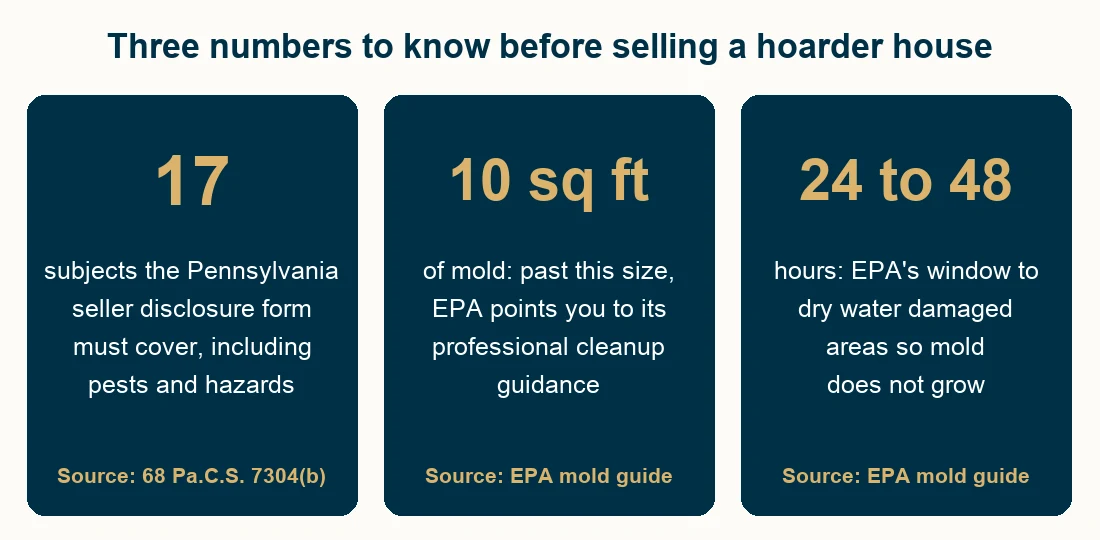
Selling as-is does not mean selling in silence. Under the Pennsylvania seller disclosure law, a seller has to disclose any material defects they know about on a property disclosure statement, and give the signed statement to the buyer before the agreement of sale is signed (68 Pa.C.S. 7303). The form covers 17 subjects, including termites, dry rot and pests, structural problems, plumbing, and the presence of hazardous substances (68 Pa.C.S. 7304).
Two details matter for a hoarder house. First, you are not required to dig through the clutter to look for problems: the law says a seller is not obligated to make any specific investigation, but must not hide a defect they know about or make statements they know are false (68 Pa.C.S. 7308). Second, if the house is being sold by an executor or administrator in the course of settling an estate, that transfer is exempt from the disclosure chapter (68 Pa.C.S. 7302). Being honest about what you do know is still the right move, and it protects the sale.
Health and Safety Issues You Should Not Tackle Alone
Hoarder houses often hide more than clutter. Moisture trapped under piles of belongings feeds mold, and stored food and paper attract pests. The U.S. Environmental Protection Agency says the key to mold control is moisture control, that water damaged areas should be dried within 24 to 48 hours to keep mold from growing, and that once mold covers more than about 10 square feet you should follow its professional cleanup guidance rather than handle it yourself (EPA, A Brief Guide to Mold, Moisture and Your Home). In a house where stored items have sat on damp floors for years, that threshold is easy to pass.
Some municipalities also cite hoarding conditions through code enforcement when they are visible from outside or reported by neighbors. An open violation has to be dealt with or disclosed, and it can scare off a financed buyer. If the property has gone further, our page on selling a condemned home explains what changes. An as-is sale does not remove the duty to be honest, but it does mean you are not stuck running a hazardous cleanup before you can move on.
How Selling As-Is to a Cash Buyer Changes the Equation
A cash buyer purchases the house in its current condition, contents and all. The boxes, furniture, and old paperwork can stay where they are. There is no requirement to clean, repair, paint, or stage before closing. Because there is no mortgage, there is no lender appraisal that depends on a move-in ready house, and no inspection contingency that gets renegotiated every time something turns up under the clutter.
That is what shortens the timeline. With no financing to wait on and no cleanout to schedule, closing can be set around your needs instead of a lender’s. Our guide on how long closing takes with a cash buyer shows where the time goes, and closing costs on a cash offer in Pennsylvania shows what comes out of your proceeds.
When the Hoarder House Was Inherited
Many owners only see the full extent of a parent’s or relative’s hoarding when the estate has to be settled. If you inherited a house like this, you are probably also dealing with probate, estate paperwork, and other heirs with their own opinions. Selling as-is takes the cleanout off an already long list. Our guides on what to do after inheriting a house in Bucks County and selling an inherited home in Pennsylvania walk through the estate steps that come before a sale.
When siblings or spouses disagree
If siblings inherited the house together, arguments about what to keep, what the house is worth, and whether to clean it first can stall a sale indefinitely. All owners generally have to sign off, so agree early on whether you are cleaning out or selling as-is. Our article on an inherited house with siblings in Pennsylvania covers how co-owners reach a decision. Divorce raises the same question about who does the work. Selling as-is sidesteps it, because the condition becomes the buyer’s job; see selling a house during a divorce in Pennsylvania.
What the Sale Looks Like, Step by Step
- You describe the property and its condition honestly. Nothing needs to be cleaned or staged first.
- A walkthrough is scheduled so the buyer sees the house as it is, contents and all.
- You get an offer based on the current, as-is condition.
- If you accept, closing is scheduled through a title company, with no bank underwriting or appraisal contingency.
- Before closing you take anything you want to keep. Everything else stays.
You can see the documents involved in our guide to cash sale paperwork in Pennsylvania, read how the whole process works on our how it works page, or get a starting number from our offer calculator.
Selling a Hoarder House to ROI National
ROI National has bought houses in the Philadelphia area since 2015, from its office at 1310 Industrial Blvd, Suite 103, in Southampton, Pennsylvania. When you sell to us, we look at the house as it stands, talk through a timeline that works for you, and make an offer that reflects its real condition, without asking you to clean, repair, or stage anything first. We are not a law firm and do not give legal advice. If an estate or disclosure question is unclear, a real estate attorney is the right person to call, and we are glad to keep the sale moving while that gets sorted out. Our frequently asked questions page answers the most common questions about a direct sale.
Frequently Asked Questions
Do I have to remove anything from a hoarder house before selling it?
No. In an as-is cash sale the buyer takes the house in its current condition, including furniture, boxes, and personal items left inside. Remove anything you want to keep before closing; the rest can stay.
Do I have to disclose hoarding damage when selling in Pennsylvania?
You must disclose material defects you know about on the seller disclosure statement, such as pests, structural problems, or hazardous substances. You are not required to search for hidden problems, and transfers by an executor or administrator settling an estate are exempt from the disclosure chapter.
What if there is mold or pest damage in the house?
Disclose what you know, but you do not have to fix it yourself before selling to an as-is buyer. EPA advises following professional cleanup guidance once mold covers more than about 10 square feet.
My siblings and I inherited the house and disagree. Can we still sell it as-is?
Yes, but all owners generally need to agree to the sale. Settling early on selling as-is, instead of cleaning out first, keeps the disagreement from delaying everything else.
Will a hoarder house sell for less?
The offer reflects the current condition, because the buyer takes on the cleanout and repairs. In exchange you skip the cost, labor, and months of carrying costs of doing that work yourself.
If you are dealing with a hoarder house in Bucks County or the greater Philadelphia area, reach out to ROI National to talk through your options with no obligation to clean, repair, or stage anything.