
If you are thinking about selling a house in Pennsylvania for cash, a common money question is the transfer tax. Who writes that check, how much is it, and does a cash sale change anything? Many homeowners assume that skipping the bank also means skipping the tax. It does not. The rules are simple once you see them laid out, and you can plan for them before you sign an agreement of sale.
This guide explains what the Pennsylvania transfer tax is, who pays it by law and by custom, how a cash sale fits in, and how ROI National handles it. It is general information, not legal or tax advice, so confirm your exact numbers with a real estate attorney or title company before closing.
If you are new to selling for cash, our step by step guide to how ROI National works shows the whole process from first call to closing day.
What the Pennsylvania Transfer Tax Is
The realty transfer tax is charged when ownership of real estate changes hands by deed. According to the Pennsylvania Department of Revenue, the state tax is “imposed at a rate of 1 percent on the value of real estate” transferred by deed. County Recorders of Deeds collect it, “often along with an additional local realty transfer tax,” and the local share can be divided between school districts and municipalities.
The local share depends on where the house sits.
Bucks County rate
The Bucks County Recorder of Deeds lists a 2% transfer tax, 1% to the state and 1% to the municipality and school district, paid at the time of recording.
Philadelphia rate
The City of Philadelphia lists 3.578% for the City plus 1% for the Commonwealth, a total of 4.578% of the sale price or assessed value.
Because the tax is tied to recording the deed, it applies whether the buyer brings a mortgage, a wire transfer, or a cashier’s check. The way the buyer pays does not create or erase the tax. The transfer of ownership is what triggers it. For the full closing cost math on your own price, try our seller closing cost calculator.
Who Pays the Pennsylvania Transfer Tax
Here is the part most sellers want to know. The Department of Revenue says “both grantor and grantee are held jointly and severally liable for payment of the tax.” In plain terms, the seller and the buyer are both on the hook, and the government can collect from either one.
Who actually pays is decided by the agreement of sale. Bucks County puts it plainly: “State and local governments do not stipulate who pays the Transfer Tax. In most sale agreements, the seller and buyer divide the tax.” Philadelphia says the tax “is usually split evenly between the buyer and the seller, but this is not a legal requirement.”
So the default most sellers meet is an equal split. It is a custom, not a rule. A buyer can agree to pay more of it, a seller can agree to absorb more of it, and the agreement of sale is where that gets written down.
What It Costs: A $250,000 Example
Here is the math on a $250,000 sale at the two published rates above. This is an illustration, not a quote.
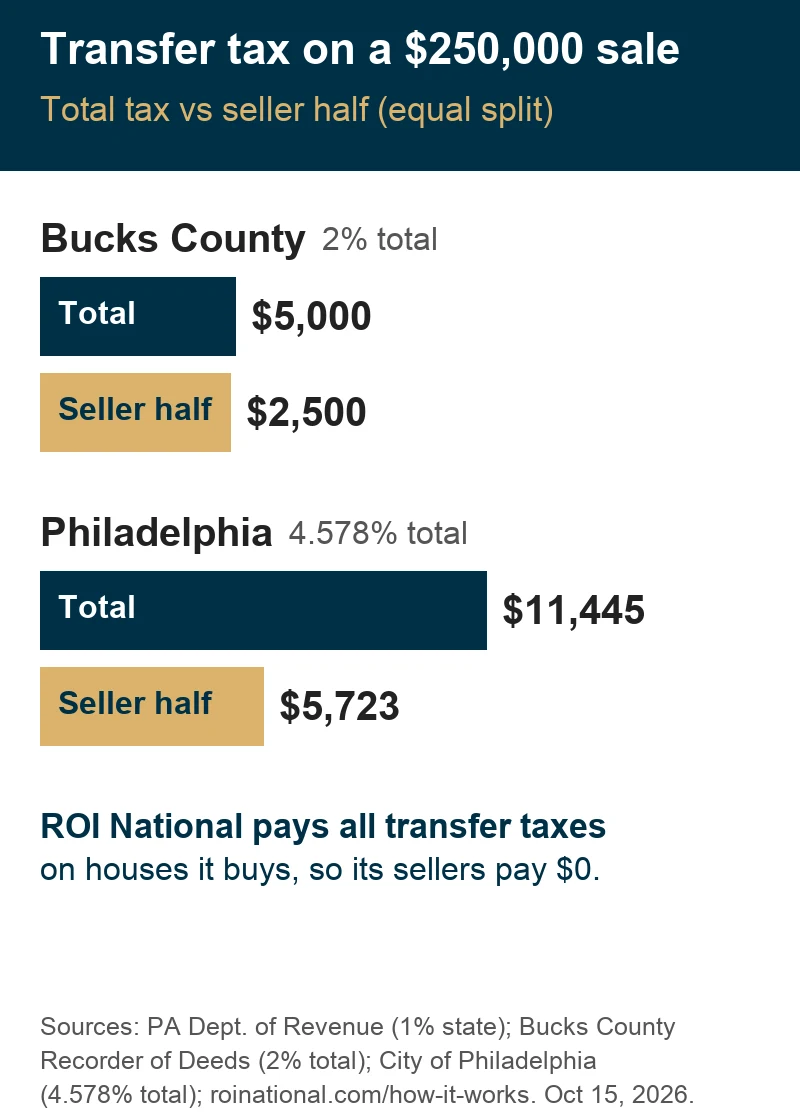
In Bucks County, 2% of $250,000 is $5,000, so an equal split leaves the seller with $2,500. In Philadelphia, 4.578% of $250,000 is $11,445, so the seller’s half is about $5,723. The total tax is the same whichever way it is divided; only the allocation changes. Bucks County also notes that the taxable value “is not necessarily the sales price,” so ask your title company to confirm the figure on your settlement statement.
How a Cash Sale Changes the Picture
Selling to a cash buyer does not change the tax law. The state and local rates stay the same. What changes is everything around it:
- No lender delays. There is no mortgage underwriting to wait on, so the timeline is usually shorter. Our guide on how long closing takes with a cash buyer walks through it.
- Fewer late surprises. A financed buyer can lose a loan approval near the end. A buyer with funds ready removes that risk.
- Closing costs are part of the offer. Cash buyers often state who covers closing costs, including the transfer tax, as part of the offer itself.
That last point matters most. Two offers with the same headline price can leave you with very different amounts after closing, depending on who pays the transfer tax and the other settlement charges. Our article on what closing costs come out of a cash offer shows every line that can appear on a Pennsylvania settlement statement.
How ROI National Handles the Transfer Tax
When ROI National buys your house, we cover all closing costs. As our how it works page puts it, that means “no title fees, no transfer taxes, no unexpected charges at closing.” The cash offer you accept is the amount you receive at closing. In the $250,000 example above, that is the difference between paying $2,500 or $5,723 as your half and paying nothing toward the tax.
Here is the rest of how a sale with us works, from the same page. We make a written cash offer within 1 hour of a short walkthrough. You pick the closing date, as soon as 7 days or further out if you need time to move. A title company handles the title search, the deed, and the closing documents, and you can suggest your own or use ours. You pay zero fees and zero commissions, and we buy houses in any condition, so there are no repairs to arrange first. See our page on selling your house in any condition for what that covers.
ROI National has bought houses in Pennsylvania since 2015 and holds a 5.0 rating across 54 Google reviews. We are not attorneys and do not give legal or tax advice, but we will show you a clear breakdown of the offer and point you to the right professionals for anything outside our lane.
Want an offer where we pay the transfer tax? Get a written cash offer with no obligation.
Family Transfers, Inherited Homes, and Other Special Cases
Not every transfer is taxed. The Department of Revenue lists exemptions that include “certain transfers among family members” and property passed by will or by intestate succession. Bucks County gives examples such as conveyances between husband and wife, parents and child, grandparent and grandchild, and brothers and sisters, and it allows a one time transfer between former spouses.
Those exemptions usually cover a transfer inside the family, not a sale to an outside buyer. Philadelphia is direct about inherited homes: “Properties purchased from an estate are not exempt.” If you inherited a house and are selling it to an unrelated buyer, expect the normal tax to apply to that sale. Our guides to selling an inherited home in Pennsylvania and selling an inherited house with siblings cover the rest of that process.
If you are selling during a divorce, our articles on selling a house during a divorce in Pennsylvania and how divorce affects selling your Pennsylvania home walk through how proceeds and closing costs are usually handled. Ask your attorney whether any exemption fits your facts before you assume one does.
A house in rough shape is still taxed on the transfer. Our article on selling a condemned or unsafe property to a cash buyer explains the options for those homes.
Compare Cash Offers on the Whole Picture
When you collect more than one cash offer, ask each buyer to put these items in writing:
- Who pays the transfer tax, and in what share?
- Who pays the title search, title insurance, and settlement fees?
- Are there any repair credits or deductions after the walkthrough?
- What is the closing date, and can it move?
- Can the buyer show proof of funds?
Our guide to comparing multiple cash offers on your house shows how to line these up side by side, and the cash vs agent calculator compares a cash sale with listing once commissions, repairs, and carrying costs are counted. If you are selling to move up, read why selling your old house for cash can make sense when you upgrade. If your house is in lower Bucks County, see our page for cash home buyers near Southampton, PA.
Frequently Asked Questions
Does the seller always pay the Pennsylvania transfer tax?
No. The buyer and seller are jointly and severally liable, and the agreement of sale decides who pays. Most agreements split it equally, but that is a custom, not a legal requirement.
Is the transfer tax lower if I sell for cash?
No. The tax is based on the value of the property transferred and applies whether the buyer pays cash or uses a mortgage. What a cash sale can change is who pays it, because many cash buyers state their closing cost terms in the offer.
How much is the transfer tax in Pennsylvania?
The state rate is 1 percent. Local governments add their own share: Bucks County lists 2% in total, and Philadelphia lists 4.578% in total. Ask your title company for the exact figure for your address.
When is the transfer tax paid?
At closing, when the deed is recorded with the county Recorder of Deeds. Your settlement statement shows each party’s share before you sign.
Does ROI National charge sellers the transfer tax?
No. ROI National covers all closing costs on the houses it buys, including title fees and transfer taxes, so the cash offer you accept is the amount you receive at closing.
Have questions about selling your Pennsylvania house for cash, or want to see an offer where the transfer tax is already covered? Contact ROI National or call (215) 278-9944. Tell us about the house and your timeline, and we will give you a written offer with no obligation.