
Selling a house is a money decision and a moving decision, and the two rarely line up on the same day. You may need a few more weeks to close on your next place, finish the school year, or pack without a deadline over your head. So one of the first things homeowners ask us is practical: how long can you stay in your house after a cash sale?
The short answer is that you stay as long as the written agreement says, and not a day longer. There is no automatic grace period once the deed changes hands. The good news is that a cash sale gives you more control over the calendar than a financed sale, and the simplest way to get more time is often to pick a later closing date rather than ask to stay after closing. This guide explains both routes, what each one costs, and what to get in writing. It is general information, not legal or tax advice.
Can You Stay in Your House After a Cash Sale Closes?
You can, but only by agreement. In a real estate transaction, ownership passes to the buyer when the deed is signed and delivered at closing. From that moment the house belongs to the buyer, and you have no right to remain unless the agreement of sale or a separate written agreement gives you one.
That is why the real question is not “how long am I allowed to stay” but “how much time do I need, and which route gets it to me with the least risk.” There are two routes:
- Move the closing date. You keep owning the house until the day you hand over the keys. Nothing changes hands early, so there is nothing to rent back.
- Stay after closing. You close, get paid, and then live in the house for a set period under a written post-closing occupancy agreement, often called a rent-back or a leaseback.
Both are normal. Which one fits depends on why you need the time and whether you need the sale money before you move.
Route One: Choose a Later Closing Date
With a financed buyer, the lender’s process sets much of the schedule. The Consumer Financial Protection Bureau notes that “Lenders are required to provide your Closing Disclosure three business days before your scheduled closing,” and appraisal, underwriting and loan approval all sit in front of that. When a buyer pays cash, there is no lender in the middle, so the buyer and seller can set the date around real life.
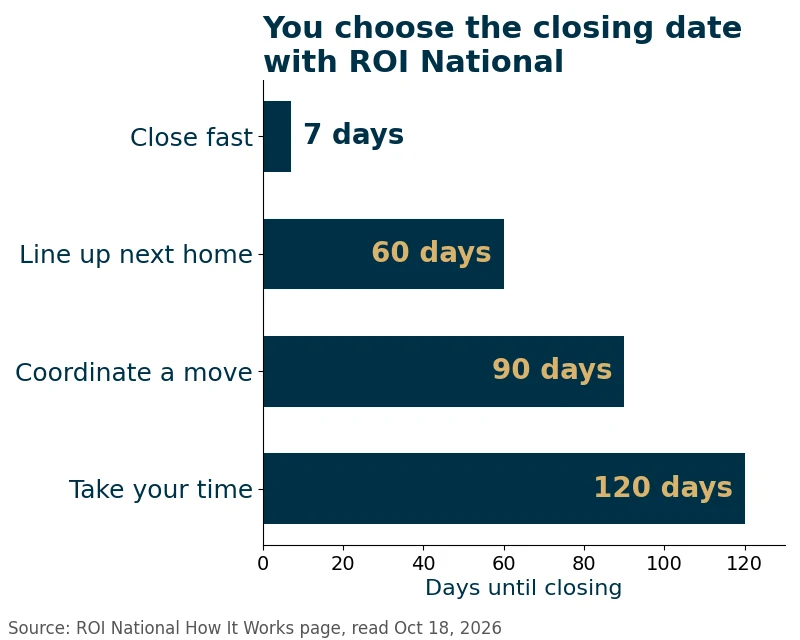
ROI National works this way. Our How It Works page says it plainly: “You choose the closing date that works for your situation.” If you need to move fast, we can close in as little as 7 days. If you need time, the same page says we are “happy to accommodate longer timelines if you need 60, 90, or even 120 days to prepare for your move.”
Why a later closing is usually the cleaner choice
If you set closing for the day you are ready to leave, you stay in your own home as the owner. You keep your own homeowners insurance, you are not anyone’s tenant, and there is no move-out deadline that comes after you have already been paid. For most sellers who simply need time to pack, find the next place, or sort a lifetime of belongings, this is the simplest answer. Our guide on how long closing takes with a cash buyer walks through the steps between an accepted offer and closing day.
When a later closing does not solve it
A later date does not help if you need the sale money to buy or rent your next home. If your down payment depends on this sale, you may need to close first and stay briefly afterward. That is where a post-closing occupancy agreement comes in.
Route Two: Stay After Closing With a Written Agreement
A post-closing occupancy agreement is a short contract in which the new owner lets the former owner keep living in the house for a set period after closing. In the industry it goes by several names: rent-back, seller leaseback, or holdover agreement. In practice you become the buyer’s short-term occupant, much like a tenant under a lease, and the buyer becomes your landlord for those days.
A clear agreement covers:
- The exact move-out date, written as a calendar date, not “about a month.”
- Any daily or monthly amount you will pay while you stay.
- Who pays utilities, trash, lawn care and small repairs during that time.
- Whether part of your sale proceeds is held back as a security deposit, and when it is returned.
- The condition the house must be in when you hand over the keys.
- What happens if you are still there after the move-out date.
Because it is a legal document that affects money held at closing, have the title company or a real estate attorney review it before you sign.
How Long After a Cash Sale Is Reasonable to Ask For?
There is no single right number, and no law sets one for a private sale. Short stays are the easiest to agree to, and buyers tend to get more careful as the request grows. A few days to a couple of weeks is usually simple. A longer stay can still work, but expect firmer terms, such as a daily charge closer to market rent or a larger holdback.
What shapes the answer:
- The buyer’s plans. A buyer who has contractors booked for the day after closing has less room than one with no work scheduled.
- The condition of the house. A buyer may hesitate to let anyone live in a home with safety problems.
- Insurance. After closing, the buyer insures the structure they now own and must be comfortable with someone else living there.
- How you ask. A specific, honest request made early gets a faster and friendlier answer than an inflated number you plan to bargain down.
If you can get the time you need by moving the closing date instead, compare the two before you commit. A later closing usually costs nothing extra.
Costs and Risks of Staying After the Sale
What staying may cost you
After closing, the buyer carries the property’s costs, so many buyers charge a daily or monthly occupancy fee. You may also be asked to leave a security deposit or a holdback from your proceeds, returned when you move out on time and leave the house in the agreed condition. Expect to keep paying for the utilities you use.
Your belongings and your insurance
Once you no longer own the house, the buyer’s policy covers the building, not your furniture or personal items. Renters insurance is the type of policy built for a tenant’s belongings and liability, so ask your insurance agent about coverage for the weeks you will be living there as a non-owner.
What happens if you overstay
This is the biggest risk. If you are still in the house after the agreed date, you may owe extra daily charges and lose some or all of your deposit, and the buyer may have to start an eviction case to recover possession. That costs both sides time, money and stress. Choose a move-out date you can actually meet, and build your moving plan with a few days of buffer before it.
What If You Need Time Because of Your Next Move?
The reasons sellers need time are ordinary, and a buyer who works with homeowners every day has heard all of them:
- Your next home is not ready. A purchase may close later than your sale, or a renovation may still be underway. If you are trading up, our piece on selling your old house for cash when upgrading covers the timing between two properties.
- Family timing. Many families want to move between school terms.
- Downsizing. Sorting decades of belongings is slow work. Our guide to downsizing after 60 in Bucks County covers how to pace it.
- A job relocation. Start dates and closing dates rarely match on their own.
One detail that saves sellers time: with ROI National you do not have to empty the house before closing. Our How It Works page answers the question “Do I need to clean out all my belongings?” with “You can remove what you want and leave the rest.” Taking only what you want to keep can shorten the time you need by days or weeks.
Staying After a Cash Sale When the House Has Problems
Some houses are hard to live in, let alone sell the traditional way. If a property has major damage, code violations, or has been declared unsafe, a buyer may not agree to let anyone stay after closing, and a local authority may limit who can live there at all. In that case the first priority is a safe and lawful exit. Our article on selling a condemned or unsafe property to a cash buyer explains how timing works in those sales. Whatever the condition, tell the buyer about it early. Surprises found after you sign an occupancy agreement can sink a deal.
How ROI National Handles the Cash Sale Timeline
ROI National has bought houses for cash in Pennsylvania, New Jersey and Delaware since 2015, from our office at 1310 Industrial Blvd in Southampton, PA. The lesson we have learned is simple: the sales that go best are the ones where the closing date and the move-out date are discussed at the start, written down, and treated as seriously as the price.
Here is how it works with us, as stated on our How It Works page:
- You get a written cash offer within 1 hour of the walkthrough, and you review it at your own pace.
- You choose the closing date, from as little as 7 days to 60, 90 or even 120 days.
- A title company handles the paperwork, title search and closing documents.
- We cover all closing costs, so there are no title fees, transfer taxes or commissions taken out of your offer.
- You take what you want from the house and leave the rest.
If you think you will need time after closing on top of that, raise it in your first conversation with us so we can talk through it and put any agreement in writing before you sign. ROI National holds a 5.0 rating from 54 Google reviews (Google Maps, checked October 7, 2026).
To weigh your options, our cash vs agent calculator compares a cash sale with a traditional listing, and our guide on how to compare multiple cash offers shows what to look at beyond the price, including flexibility on dates. If you live near our office, see cash home buyers near Southampton, PA and our guide to selling your house fast in Bucks County, PA. Selling a house in poor shape? See how we buy houses in any condition.
A note on taxes
Selling a home can have tax consequences. The IRS Topic 701 explains that if you have a capital gain from the sale of your main home, “you may qualify to exclude up to $250,000 of that gain from your income, or up to $500,000” if you file a joint return with your spouse, when you meet its ownership and use tests. A short stay after closing does not usually change that, but a tax professional can confirm how the capital gains tax rules apply to you.
Checklist Before You Agree to Stay After the Sale
- Decide whether a later closing date gets you the time you need. If it does, use it.
- If you must close first, write the exact move-out date and what “moved out” means: keys returned, house empty of what you are taking, final walkthrough done.
- Agree on any daily or monthly charge and how it is paid or deducted.
- Agree on who handles utilities, repairs and yard care while you stay.
- Confirm the deposit or holdback amount and when it comes back.
- Ask your insurance agent about coverage for your belongings and liability.
- Have the title company or an attorney review the agreement before closing.
Frequently Asked Questions
Is there a legal minimum amount of time I can stay after a cash sale?
No. Once the sale closes and the deed transfers, you have no automatic right to remain. Any time you stay after closing must be agreed in writing, usually in a post-closing occupancy or rent-back agreement.
Is it better to delay closing or rent back after closing?
If you do not need the sale money before you move, a later closing date is usually simpler: you stay as the owner and nothing changes hands early. A rent-back makes sense when you need the proceeds to pay for your next home before you move.
Will I have to pay to stay in the house after closing?
Often, yes. The buyer now owns the house and carries its costs, so many buyers ask for a daily or monthly payment, a deposit, or both. You usually also pay for the utilities you use. The terms are negotiable and belong in the written agreement.
What happens if I do not move out by the agreed date?
You may owe extra daily charges, lose some or all of your deposit, and the buyer may have to start an eviction case to recover possession. Choose a move-out date you can meet and treat it as firm.
How much time does ROI National give sellers before closing?
You choose the closing date. ROI National can close in as little as 7 days, and its How It Works page says it is happy to accommodate 60, 90 or even 120 days if you need time to prepare for your move.
Thinking about a cash sale and wondering how much time you will have in your home? Contact ROI National or call (215) 278-9944, seven days a week. Tell us your timeline and we will give you a written offer with a closing date that fits it, with no obligation.