
A cash sale can take a house from “for sale” to “sold” in days instead of months. That speed is why so many Philadelphia area homeowners choose it, whether they are facing foreclosure, handling an inherited property, relocating, or simply done with showings and repairs. But speed only helps you if the contract is clear and fair to both sides. This guide lists the questions to ask before signing a cash sale contract, grouped by the part of the deal they protect: who is buying, the price, the fees, the timeline, the exits, and the condition of the house.
If you want to see how a cash sale runs from first call to closing day first, our step by step guide to how ROI National works lays out the whole process.
Why the Contract Deserves a Close Read
A cash sale contract is usually shorter than a traditional agreement of sale because there is no mortgage contingency, no lender conditions, and no appraisal clause. That simplicity is part of the appeal, and it is also why some sellers skim it. Every line still carries legal weight. The price, the closing date, who pays which fees, what happens if the buyer walks away, and what condition the house must be in at closing are all set by the words on the page, not by anything said out loud during the walkthrough.
Ask for a copy before the signing appointment, read every page, and get anything unclear answered in writing. A legitimate buyer will not rush you past this step.
Questions About Who Is Actually Buying Your House
Not every “cash buyer” is the same business. Some buy and hold or renovate the house themselves. Others sign a contract and then assign it to a different investor before closing. Ask:
- Is your company the buyer, or can this contract be assigned to someone else before closing?
- If it can be assigned, who is responsible for closing on time, and do I have to approve the new buyer?
- Can you show proof of funds for this purchase?
- How long have you been buying houses in this area, and where is your office?
Assignment is not illegal, but you deserve to know who will own your house and who is on the hook for the closing date. Our guide on how to spot a legitimate cash home buyer near you covers the warning signs in more detail, and if you are in the northern suburbs, see what a local buyer looks like on our page about cash home buyers near Southampton, PA.
Questions About the Price
The offer number matters, and so does how the buyer reached it. Ask:
- What did you base this number on: comparable sales, condition, repair costs?
- Is the price in the contract final, or can it change after a second visit or an inspection?
- Is the amount on the contract the amount I will receive at closing, or will anything be deducted from it?
Watch for language that lets the buyer reduce the price after signing, sometimes framed as an inspection period or a “subject to walkthrough” clause. ROI National’s own published process states that its offer is based on local market conditions, the property’s location and size, its condition, comparable sales, and the repair costs the company will take on, and that the number given is the amount the seller receives at closing, with no last-minute renegotiation.
It also helps to know what the house might bring on the open market with an agent so you can weigh speed and certainty against a possibly higher but slower sale. Our cash vs agent calculator puts the two side by side, and our guide on how to compare multiple cash offers shows what to check beyond the headline number.
Questions About Closing Costs and Fees
Fewer fees is one of the main reasons sellers choose cash, but “fewer” is not the same as “none” unless the contract says so. Ask specifically who pays for:
- The title search and title insurance.
- Realty transfer tax. In Pennsylvania the state portion is 1 percent of the property’s value, often collected along with an additional local transfer tax, and the Department of Revenue notes that both the seller and the buyer are jointly liable for it (Pennsylvania Department of Revenue).
- Recording fees and any settlement or document preparation fees.
- Outstanding liens, judgments, back taxes, or municipal charges.
Get the answer written into the contract. On transfer taxes in particular, a verbal “we’ll take care of it” is not enough when the law makes both parties liable. ROI National states that it covers all closing costs, including title fees and transfer taxes. For a full breakdown, read what closing costs come out of a cash offer, and if your property carries a lien or HOA balance, see how judgment liens and HOA dues affect a sale.
Questions About the Timeline
“Fast” needs a date attached to it. Ask:
- What closing date is written in the contract, and who chose it?
- What happens if the buyer is not ready on that date?
- If I need more time to move, can the closing be later, and is that written down?
- Which title company will handle closing, and can I pick my own?
Some contracts say “within 30 days” instead of naming a date, which gives the buyer flexibility you may not want. ROI National lets the seller choose the closing date, from as soon as 7 days to 60 days or longer, and says sellers can suggest their own title company or use the one ROI works with.
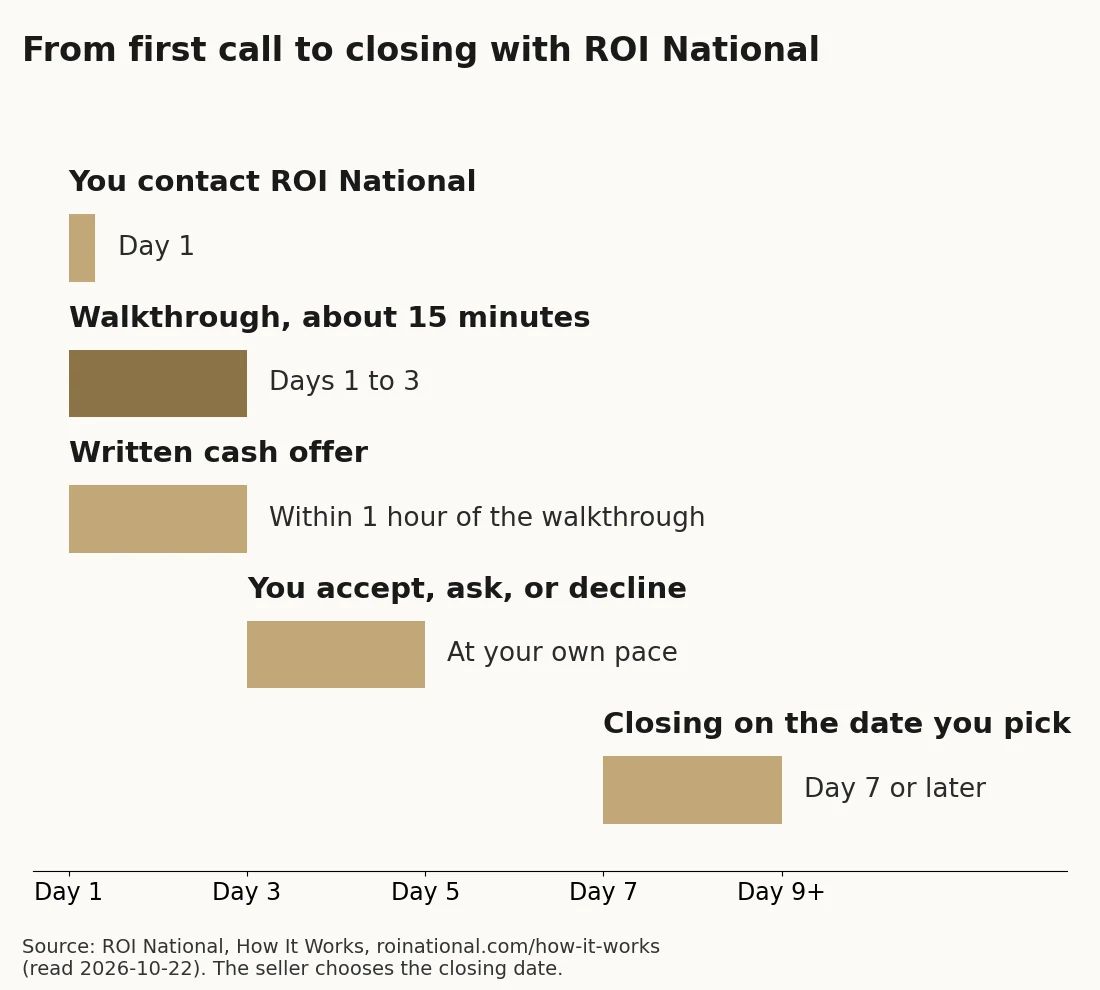
For what affects the calendar between signing and settlement, see how long closing takes with a cash buyer. If you are selling because you are moving into a new home, our article on selling your old house for cash when upgrading covers how to line up the two dates.
Questions About Contingencies and Your Right to Cancel
Contingencies are the conditions that must be met before closing, and each one is a possible exit. Ask what is in your specific agreement:
- Is there an inspection contingency, and how many days does it run?
- Is there a title contingency, and what happens if the title search turns up a problem?
- Is there any financing contingency? Some “cash” buyers still use short-term loans.
- Is there an earnest money deposit, how much is it, who holds it, and when is it released?
- What are my own rights to cancel, and under what conditions?
Why the Cancellation Terms Matter
If the buyer has several ways out and you have none, the contract is lopsided. Any right you have to cancel has to come from the contract language, so if your agreement does not spell one out, ask why. This is the point where a short review by a real estate attorney earns its fee. ROI National is not a law firm, and nothing here is legal advice for your specific sale.
Questions About Repairs and As-Is Terms
Most cash contracts include an as-is clause: the buyer takes the house in its current condition and you do not make repairs. Ask exactly what that covers in your contract:
- Does as-is mean no repairs, no cleaning, and no cleanout of belongings?
- Can the buyer still ask for a credit or a lower price after an inspection?
- Does anything have to be removed from the house before closing?
As-is describes the buyer’s promise about repairs. It does not change what you must tell the buyer. Pennsylvania’s seller disclosure law says a seller who intends to transfer property must disclose material defects they know about on a property disclosure statement and deliver a signed and dated copy before the agreement of transfer is signed (68 Pa.C.S. 7303). The same chapter says a seller does not have to investigate to complete the statement but must not make representations they know are false (68 Pa.C.S. 7308). Ask the buyer when you will receive the disclosure form, and fill it out before you sign. If the house has open code issues, our guide to selling a house with code violations in Pennsylvania and our article on selling a condemned or unsafe property explain the extra paperwork.
Questions About Closing Day
Finally, ask what closing itself will look like so nothing on the day comes as a surprise:
- Where will we sign, and how long will it take?
- What should I bring?
- How will I be paid: wire transfer, cashier’s check, or another method?
- When do I hand over the keys?
With ROI National, closing happens at the title company and usually takes 30 to 60 minutes; sellers bring a government-issued photo ID and the keys, and payment can be a cashier’s check or a wire transfer. Our checklist of the paperwork you need to sell a house for cash covers anything else to gather in advance.
How to Verify Everything Before You Sign
After you have your answers, do a few independent checks:
- Compare every verbal promise with the written contract. If it is not on paper, ask for it to be added.
- Confirm the buyer’s business name, office address, and how long they have operated.
- Read reviews from other sellers, not only testimonials on the buyer’s own site.
- Ask a real estate attorney or the title company to look over anything you do not understand.
A legitimate buyer will not object to any of this. If someone pressures you to sign on the spot, treat the pressure itself as a warning sign.
About ROI National

Illustration.
ROI National is a cash home buyer serving Pennsylvania, New Jersey, and Delaware since 2015, from 1310 Industrial Blvd, Suite 103, Southampton, PA. The company holds a 5.0 rating across 54 Google reviews. Offers are written, arrive within 1 hour of a walkthrough of about 15 minutes, and come with no obligation. The phone line, (215) 278-9944, is answered seven days a week. For sellers in the city, our Philadelphia quick home sale page explains how a fast sale is set up.
Have a cash offer in hand and questions about the contract?
Frequently Asked Questions
Do I need a real estate attorney to review a cash sale contract?
It is not always required, but it is a smart precaution, especially if any term is unclear or the property has liens, code violations, or title issues. An attorney can point out terms that favor the buyer more than you.
Can a cash buyer back out after signing the contract?
It depends on the contingencies in the agreement. Inspection, title, and financing contingencies can each give a buyer a way out, so ask exactly which ones apply and how long they last.
Who pays the realty transfer tax in a Pennsylvania cash sale?
Pennsylvania’s Department of Revenue says the seller and buyer are jointly liable for the tax, which is 1 percent at the state level plus any local tax. Who actually pays it is set by the contract, so get it in writing. ROI National states that it covers all closing costs, including transfer taxes.
What does as-is mean in a cash sale contract?
It generally means the buyer accepts the house in its current condition without repairs. Some contracts still allow a price change after inspection, so confirm whether the price is final. As-is does not remove your duty to disclose known material defects under Pennsylvania law.
Can the contract be assigned to another buyer?
Some cash contracts include an assignment clause that lets the buyer transfer the deal to another investor before closing. Ask whether yours does, and who is responsible for closing on time if it is assigned.
Weighing a cash offer and want a straight answer to any of the questions above? Contact ROI National or call (215) 278-9944.