
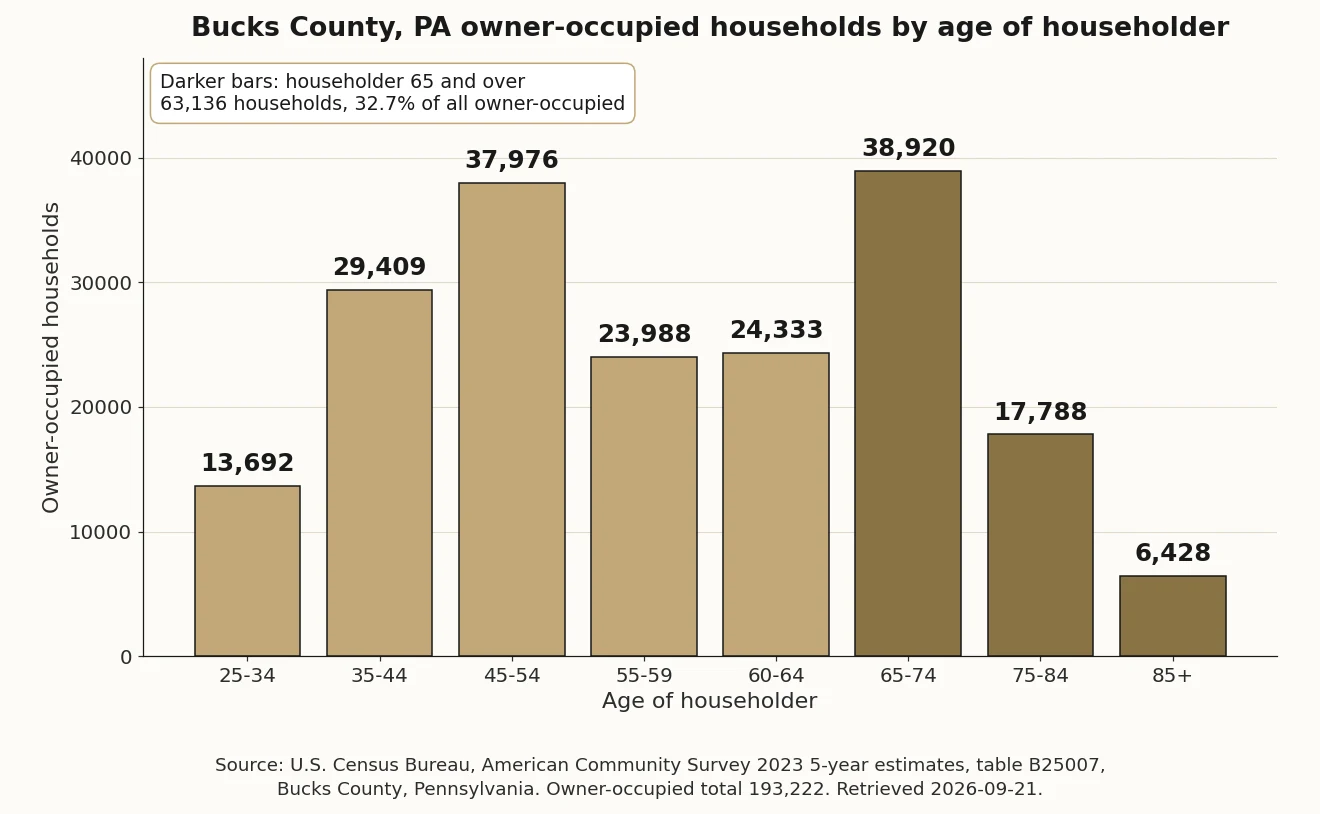
This comes up far more often than people expect. In Bucks County there are 193,222 owner-occupied households, and 63,136 of them, about one in three, have a householder aged 65 or over [U.S. Census Bureau, ACS 2023 5-year estimates, table B25007, retrieved 2026-09-21]. A reverse mortgage is only available to older homeowners, so that age band is the pool where these sales come from, and it is a large one.
Yes, you can sell a house that has a reverse mortgage balance on it. A reverse mortgage is still a loan against the property, and like any mortgage, it has to be paid off when the home is sold, refinanced, or vacated. The good news is that selling a house with a reverse mortgage is not as complicated as most people fear, but it does come with a few extra steps and a tighter timeline than a typical sale, especially if the loan is being paid off after the borrower has passed away or moved into long-term care.
If you are an heir, a family member, or a homeowner who is trying to figure out what a reverse mortgage means for selling the property, this guide walks through how the payoff works, what happens if the home is worth less than the balance owed, and what your options are if you need to sell quickly.
What a Reverse Mortgage Balance Actually Is
A reverse mortgage, most commonly a Home Equity Conversion Mortgage (HECM) insured by the Federal Housing Administration, lets a homeowner age 62 or older borrow against the equity in their home. Instead of the homeowner making monthly payments to the lender, the lender pays the homeowner, either as a lump sum, monthly payments, or a line of credit. The loan balance grows over time because interest and fees are added to what is owed rather than paid down.
That balance has to be repaid eventually, and the most common trigger is the sale of the home. Other triggers include the borrower passing away, moving out permanently, or failing to keep up with property taxes, insurance, or basic maintenance required by the loan terms. You can read more about the HECM program directly from the U.S. Department of Housing and Urban Development, which oversees the program.
How the Payoff Process Works at Closing
When you sell a house with a reverse mortgage, the process looks a lot like paying off any other mortgage at closing. The title company or closing attorney requests a payoff statement from the reverse mortgage servicer. That statement shows exactly what is owed as of the closing date, including accrued interest and any fees. At closing, the proceeds from the sale first go toward satisfying that balance, and whatever is left over (if anything) goes to the seller or the estate.
The main difference from a traditional mortgage payoff is timing. Reverse mortgage servicers can be slower to respond, especially when the loan is being closed out due to the borrower’s death, because they often require a death certificate, proof of authority to act on behalf of the estate, and other documentation before they will even release a payoff quote. Planning for that lag matters if you are working against a deadline.
What Happens If the House Is Worth Less Than the Balance Owed
Because a reverse mortgage balance grows every month, it is common for the loan balance to end up close to, or even higher than, the current market value of the home, particularly if the loan has been in place for many years or if the home needs repairs. This does not mean you are stuck. FHA-insured HECM loans are non-recourse, meaning the borrower (or the estate) is never on the hook for more than the home is worth. If the home sells for less than the payoff amount on an arm’s-length sale, an FHA-insured HECM is a non-recourse loan, which means the borrower or the estate is not personally on the hook for the shortfall. The insurance behind the program absorbs it. Separately, there is a rule that lets heirs who want to KEEP the house satisfy the debt at a percentage of appraised value rather than the full balance. Those are two different situations and they get confused constantly. Confirm which one applies to you with the loan servicer in writing before you make any decision.
This is one of the more misunderstood parts of reverse mortgages. Families sometimes assume they have to come out of pocket to cover a gap between the sale price and the loan balance, and that is generally not how it works with an FHA-insured loan. Selling a property in this situation is very similar to selling any house in less than perfect condition, which is where working with a buyer who understands distressed and as-is sales can make the process much smoother. If the home also needs repairs or has deferred maintenance, our guide on how to sell a damaged house in Pennsylvania covers what to expect when a property is not in market-ready shape.
Selling to a Cash Buyer vs. Listing Traditionally
Homeowners and heirs dealing with a reverse mortgage balance often have two realistic paths: list the home on the open market through an agent, or sell directly to a cash buyer. Both can work, but they fit different situations.
Listing traditionally can make sense when the home is in good condition and there is enough equity to cover agent commissions, repairs, and closing costs while still leaving proceeds behind. But a traditional listing also means showings, inspections, buyer financing contingencies, and a timeline that can stretch for months, none of which fit well when a reverse mortgage servicer is applying deadline pressure or when out-of-town heirs cannot manage an ongoing sale process.
Selling directly to a cash buyer removes several of those obstacles. There is no need to make repairs, no financing contingency to worry about, and closing can happen on a schedule that matches the reverse mortgage payoff deadline instead of the buyer’s mortgage approval. This is especially useful when:
- The home needs work that the estate does not have funds to pay for
- Multiple heirs need to sell quickly and split proceeds without ongoing disagreements
- The reverse mortgage servicer has set a firm deadline before initiating foreclosure
- The property sits outside the area and no one can manage repairs, showings, or ongoing maintenance
If the property has any condition issues at all, our page on how we buy houses in any condition explains how a sale can move forward without repairs, cleanouts, or staging.
Selling While the Homeowner Is Alive Versus After They Have Passed
These are two different sales and it is worth being clear which one you are in. When the borrower is still living and chooses to sell, they are simply a homeowner with a loan to pay off. They control the timing, they can list or sell whenever they want, and the balance gets settled at closing like any other mortgage payoff. The common reasons are downsizing, a move closer to family, or a move into assisted living, and that last one matters because a reverse mortgage generally becomes due once the home stops being the borrower’s principal residence.
When the borrower has passed away, the people selling are the heirs or the estate, and the loan has already come due. Now there is a clock, the estate may need to be opened before anyone has authority to sign, and the servicer is waiting on a decision. Families in that position are usually handling the property question on top of everything else, which is covered in our guides to selling an inherited home in PA and to an inherited house with siblings.
Deadlines Heirs Need to Know About
When the borrower on a reverse mortgage passes away, the loan servicer typically sends a due-and-payable notice to the estate or heirs. From there, heirs are generally given a set window, often around six months, with the possibility of extensions, to either pay off the loan, sell the property, or turn the deed over to the lender. Missing these deadlines without communicating with the servicer can lead to foreclosure, which is why moving quickly matters.
This is often the exact situation heirs face when a property comes to them through probate. If you have recently inherited a house with a reverse mortgage attached, our guide on what to do after you have inherited a house in Bucks County, PA walks through the early steps, including how the payoff and probate timelines usually intersect.
Things get more complicated when the home is inherited by multiple siblings who may not agree on whether to sell, keep, or fix up the property. Disagreements among heirs can eat up valuable time while the reverse mortgage balance continues to accrue interest. Our article on handling an inherited house with siblings in PA covers how families work through those decisions without letting the clock run out on the servicer’s deadline.
Common Complications That Slow Down the Sale
A handful of issues tend to come up repeatedly when selling a house with a reverse mortgage balance, and knowing about them ahead of time can save weeks of delay:
- Slow payoff quotes. Servicers can take longer than a standard lender to produce a payoff statement, particularly after a death, so requesting it early is worth doing.
- Deferred maintenance. Because reverse mortgage borrowers are often older and may not have been able to keep up with repairs, the home may have deferred maintenance, code issues, or outdated systems that scare off traditional buyers relying on financing.
- Property condemnation risk. In more serious cases, a neglected property can end up flagged as unsafe by the local municipality. If that has already happened, our page on selling a condemned or unsafe property explains how cash buyers can still close on homes that would otherwise be very difficult to sell.
- Local code violations. Some municipalities require a use and occupancy inspection or resolution of open violations before a title transfer, which can stall a traditional sale. Our guide on how to sell a house with code violations in PA explains how that process works and where cash sales avoid the bottleneck.
- Lien and title issues. Beyond the reverse mortgage itself, older homes sometimes carry other liens, unpaid taxes, or title defects that need to be cleared before closing.
Steps to Take Before You List or Sell
Whether you plan to list traditionally or sell directly, a few steps make the process go faster and reduce surprises at closing:
- Request a written payoff statement from the reverse mortgage servicer as early as possible, since it can take time to process.
- Confirm who has legal authority to sell the property, whether that is the borrower, an executor, or an heir, since title companies will require this documentation.
- Get a general sense of the home’s current value so you can compare it against the payoff amount and understand whether there will be proceeds left over.
- Ask the servicer about any deadline extensions available if you need more time to sell.
- Decide early whether repairs are realistic given the timeline and available funds, since that decision drives whether a traditional listing or a direct cash sale makes more sense.
If time pressure is the biggest factor, for example, a family member relocating for a new job and needing to close out an estate property quickly, it helps to look at how fast a sale can realistically move. Our guide on selling a house fast in Bucks County when relocating for work and our full guide to selling your house fast in Bucks County, PA both cover realistic timelines for a fast, uncomplicated closing.
Where ROI National Fits, and Where We Do Not
ROI National is a family-owned cash home buyer based in Southampton, Pennsylvania, buying houses across Pennsylvania, New Jersey, and Delaware since 2015 (about ROI National). What matters in a reverse mortgage sale is that we buy as-is and we do not need the property repaired or cleared out first, so a house that has been lived in for decades does not have to be made market-ready before anyone will talk numbers.
We are not the loan servicer, we are not attorneys, and we are not tax advisors. The payoff figure, the deadline you are actually working against, and any extension all come from the servicer in writing, and the estate questions belong with a Pennsylvania attorney. HUD publishes the program details for Home Equity Conversion Mortgages on its HECM program page. What we can do is give you a firm number and a closing date you can take back to the servicer, so the decision stops being open ended.
If the property also needs work, the same as-is approach covers a damaged house, a house in any condition, and one carrying code violations.
Frequently Asked Questions
Can I sell my house if I still have an active reverse mortgage?
Yes. You can sell at any time, and the reverse mortgage balance is paid off out of the sale proceeds at closing, just like a traditional mortgage.
What happens if the reverse mortgage balance is higher than what the house sells for?
If the loan is an FHA-insured HECM, it is non-recourse, which means the borrower or the estate does not owe the difference after an arm’s-length sale. A separate rule applies when heirs want to keep the property instead of selling it. Ask the servicer in writing which rule governs your situation, because the two are easy to mix up. Mortgage insurance covers the remaining shortfall.
How long do heirs have to sell a house after the reverse mortgage borrower passes away?
Servicers typically issue a due-and-payable notice and give heirs a window, often around six months with possible extensions, to sell the home, pay off the balance, or transfer the deed. Exact timelines vary by servicer, so it is worth confirming directly with them.
Do I have to make repairs before selling a house with a reverse mortgage?
Not necessarily. If you sell to a cash buyer who purchases homes as-is, repairs are not required. If you list traditionally, buyers relying on financing may require certain repairs to be completed first.
Can multiple heirs sell an inherited house together if it has a reverse mortgage balance?
Yes. Heirs can jointly sell an inherited property, though all parties with legal authority generally need to agree and sign off at closing. Working through disagreements early helps avoid delays against the servicer’s deadline.
If you are dealing with a reverse mortgage balance on a home you need to sell, whether you are the borrower, an heir, or handling an estate, reach out to ROI National. We can walk through your specific payoff situation, timeline, and property condition, and let you know what a straightforward, as-is cash sale would look like for your circumstances.