
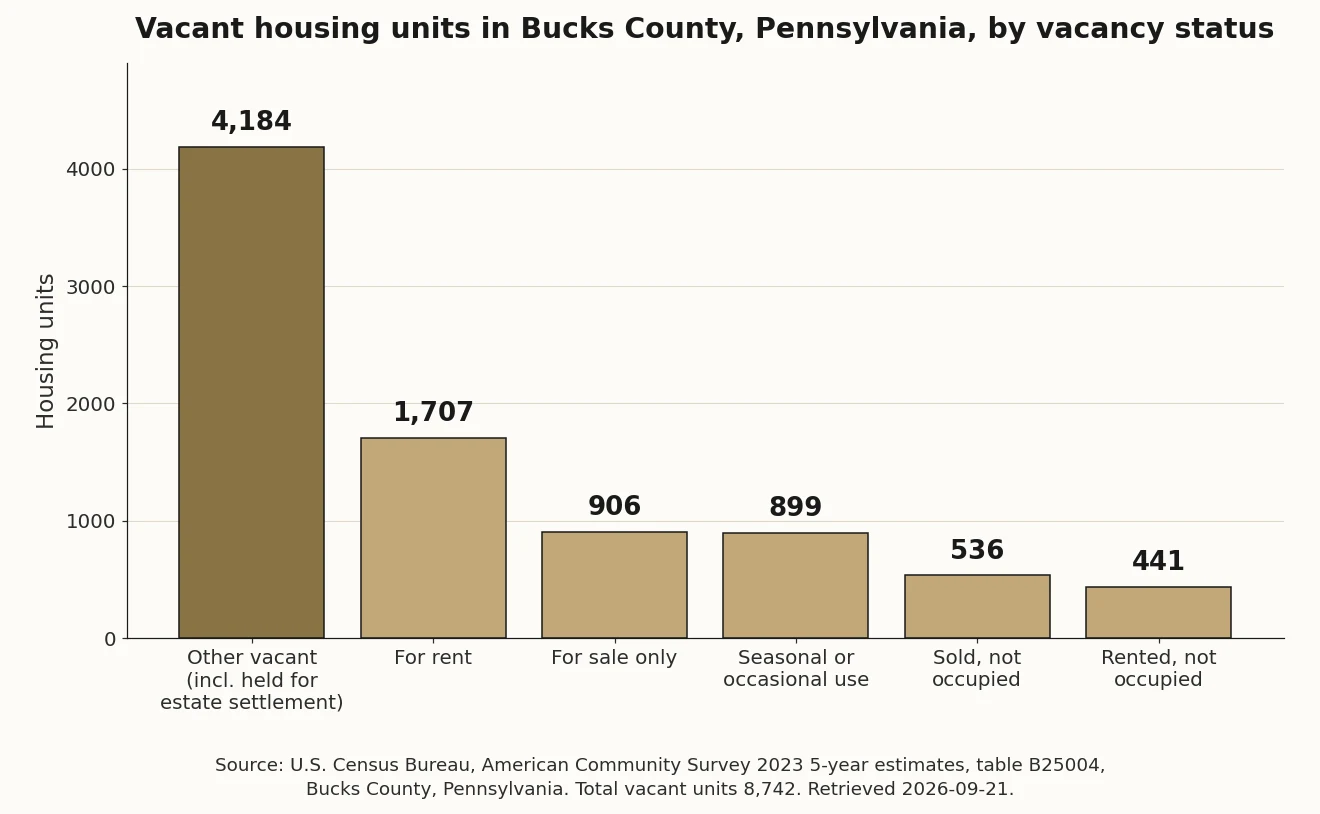
Vacant homes are where this problem starts. The Census Bureau counts 8,742 vacant housing units in Bucks County, and 4,184 of them, nearly half, fall into the “other vacant” category, meaning they are not for rent, not for sale, and not seasonal homes [U.S. Census Bureau, ACS 2023 5-year estimates, table B25004, retrieved 2026-09-21]. That category is where houses held for the settlement of an estate sit, and a house nobody is checking on is the kind of house an unauthorized occupant finds.
Finding out that someone is living in a property you own, without your permission and without paying rent, is one of the most stressful situations a property owner can face. The next question almost always follows immediately: can you still sell the house, or are you stuck until the situation is resolved? The honest answer is that selling a house with a squatter in it is more complicated than a normal sale, but it is not impossible. What matters most is understanding what you are legally allowed to do, how a squatter situation affects buyer interest, and which sale paths actually work when someone is occupying a property you did not invite them into.
This guide walks through the legal basics, why traditional buyers usually walk away from these situations, and what realistic options exist for getting the property sold.
What “Squatter” Actually Means in a Real Estate Context
A squatter is someone occupying a property without the owner’s permission and without a lease. This is different from a tenant who stopped paying rent, and it is different from a holdover tenant whose lease expired but who has not moved out. Each of these situations is treated differently under the law, and the difference matters because it determines what legal process you have to go through to remove the person and how long that process might take.
Some squatters end up in a property because a lock was left unsecured on a vacant home. Others move in through a fraudulent lease they created themselves, sometimes even collecting “rent” from a subtenant who has no idea the arrangement is illegitimate. Inherited properties, vacant rentals, and homes sitting empty during a long renovation or a slow sale process are the most common targets. If you inherited a property and are now dealing with an unexpected occupant, the situation often overlaps with broader inheritance complications. Our guide on what to do after inheriting a house in Bucks County covers the early steps that matter before you even get to a squatter problem.
Can You Legally Sell a House That Has a Squatter In It
Yes. Ownership of the property and occupancy of the property are two separate legal facts. You can hold clear title and sell that title to a buyer even while someone else is physically living in the home. The deed transfers ownership, not eviction status. However, you cannot force the buyer to accept a property with an unresolved occupant unless the buyer knows about the situation and is willing to take it on, and most buyers are not.
This is the core tension in these deals. Legally, nothing stops the sale itself. Practically, the presence of a squatter changes who will buy the house, what they will pay, and how the closing has to be structured.
Why Traditional Buyers and Retail Sales Fall Apart
A conventional buyer using a mortgage almost never wants to close on a property with an unauthorized occupant still inside. Lenders generally require the property to be delivered vacant, and most loan underwriting will not move forward if there is an active occupancy dispute, a pending eviction, or any question about who has the legal right to be in the home. Title companies also get cautious, since an occupant claiming any kind of possessory right can raise title insurance concerns. Beyond the financing issue, most retail buyers simply do not want the headache. Buying a home means picturing yourself living there. A squatter situation introduces uncertainty about move-in timing, potential property damage, and the emotional weight of knowing someone had to be legally removed. Even buyers who are otherwise interested in the property will often cut their offer or walk away once they learn about the occupancy issue, especially if it is disclosed late in the process. This is similar to what happens with other complicated property conditions. Homes with unresolved code violations or structural and water damage face the same buyer hesitation, just for different reasons. In both cases, the property is legally sellable, but the pool of buyers willing to take it on shrinks fast.
The Legal Process for Removing a Squatter Before You Sell
Owners often ask whether an occupant can eventually claim ownership of the property outright. That doctrine is called adverse possession, and it requires continuous, open, and exclusive occupancy for a long statutory period, commonly measured in years rather than months, so it almost never applies to a recent squatter situation. The realistic concern is not losing title, it is the time and cost of the removal process itself.
Most sellers assume they can simply call the police and have a squatter removed like a trespasser. In practice, once someone has established some period of occupancy, many jurisdictions require a formal eviction process rather than a simple trespassing removal, even if the person never had a lease. Police departments are frequently reluctant to remove an occupant without a court order, because doing so can expose them to liability if the occupant later claims tenant rights. The general path looks like this:
- Document the occupancy: photos, dates you first noticed the person there, any communication, and whether utilities are being used
- Post any required notice to vacate, following your state and local requirements exactly
- File for eviction in the appropriate court if the person does not leave voluntarily
- Obtain a court order and, if necessary, have law enforcement carry out the removal
This process can take anywhere from a few weeks to several months depending on the jurisdiction, whether the occupant contests the eviction, and how backed up the local court system is. For sellers on a deadline, whether because of a job relocation, financial pressure, or simply wanting the situation resolved, this timeline is often the single biggest obstacle. It is also why many owners in this position start looking at faster, more flexible sale paths rather than waiting out a court process before listing the home traditionally.
What Pennsylvania Law Actually Says, and Why It Matters Here
Pennsylvania handles removals under the Landlord and Tenant Act of 1951 (Act of April 6, 1951, P.L. 69, No. 20). Under Section 501 of that Act, a landlord repossessing from a tenant serves a written notice to quit, and the required period is set by the lease: fifteen days where the lease runs one year or less or for an indeterminate term, thirty days where the lease runs more than one year, and ten days where the issue is unpaid rent [Landlord and Tenant Act of 1951, Section 501(b), retrieved from the Pennsylvania General Assembly 2026-09-21].
Here is the part that surprises most owners. Those timelines describe a landlord and a tenant. Someone who never had a lease with you is not your tenant, so the summary landlord-tenant process is not automatically the right vehicle. Section 511 of the same Act preserves the separate remedy of ejectment, an action to recover possession brought in the Court of Common Pleas, which is the route that typically applies when there is no landlord-tenant relationship to terminate in the first place [Landlord and Tenant Act of 1951, Section 511, retrieved 2026-09-21]. Ejectment is a full civil action rather than a summary proceeding, which is a large part of why these situations run long.
Which path fits your situation depends on facts a court will weigh, including whether any rent was ever paid, whether a written or verbal arrangement existed, and how long the occupancy has run. That determination belongs with a Pennsylvania attorney, not with a buyer and not with this guide. The practical point for a seller is simply that the calendar is usually longer than the fifteen or thirty days people expect from the notice periods they find online.
Selling to a Cash Buyer While the Squatter Situation Is Unresolved
This is where the situation opens up more than most sellers expect. Buyers who purchase properties for cash, without financing contingencies and without needing the home in move-in condition, are generally far more comfortable taking on a property with occupancy issues. These buyers often have experience navigating eviction timelines, budgeting for cleanup and repairs after a squatter leaves, and structuring a purchase agreement that accounts for the current condition of the home, occupant included. A cash sale in this scenario typically works one of two ways. Either the seller and buyer agree on a price that reflects the situation as-is, with the buyer taking on the responsibility of resolving the occupancy after closing, or the seller handles the removal first (sometimes with guidance from the buyer or the buyer’s attorney) and then the sale proceeds like a normal cash transaction. Which approach makes sense depends on how urgent the seller’s timeline is and what the buyer is willing to take on. This is the same logic that applies to other properties that fall outside what a retail buyer wants to touch. Homes described as being in any condition, including major repairs, or homes affected by fire, water, or structural damage, follow a similar pattern: the traditional market shrinks, but a specialized buyer pool remains willing to move forward.
How a Squatter Situation Affects Price and Timeline
It would be misleading to say a squatter has no effect on what a property is worth to a buyer. Any buyer taking on the occupancy issue is also taking on real costs: legal fees for eviction if needed, potential property damage from the occupant, lost time while the process plays out, and the general risk that comes with an unresolved legal matter. Those costs get factored into the offer. That said, the alternative for many sellers is not a higher price from a traditional buyer, it is no sale at all until the situation is resolved through the court system, which can take months and cost money of its own in legal fees, lost mortgage or tax payments, and continued exposure to whatever damage the occupant might cause. Weighing a lower but immediate offer against months of holding costs and legal uncertainty is a real financial calculation, not just a convenience decision. Sellers facing time pressure for other reasons, such as a job move, often go through this same math. Our guide on selling a house fast when relocating for work covers how urgency changes the sale strategy even without a squatter involved, and the same principles apply here, just with an added legal layer.
What Happens When the Property Was Inherited
Squatter situations show up disproportionately often in inherited properties, for a simple reason: inherited homes frequently sit vacant for extended periods while the estate is being settled, siblings are deciding what to do, or the property is between renters. A vacant home is a visible target. If you are dealing with an inherited property that now has an unauthorized occupant, you are often managing two separate complications at once: the estate or probate process, and the occupancy issue. If there are multiple heirs involved, decisions about how to handle the squatter, whether to pursue eviction or sell as-is, can become another point of disagreement among family members who may already be navigating a difficult situation. Our resource on handling an inherited house with siblings addresses how to work through shared-ownership decisions, which becomes especially relevant when one sibling wants to pursue a lengthy eviction and another wants to sell quickly and let the buyer handle it.
When the Situation Escalates: Condemned or Unsafe Property
In some cases, a squatter situation is compounded by the physical condition of the property itself. Long-term unauthorized occupancy without utilities, ongoing maintenance, or basic upkeep can lead to code violations, safety hazards, or even a condemnation notice from the local municipality. When a property reaches that point, the pool of potential buyers narrows even further, since most owners and even many investors are unwilling to take on a home that is both occupied by a non-tenant and structurally or legally at risk. If your property has reached this stage, it helps to understand how buyers who specialize in condemned or unsafe property approach these deals, since the same buyer network that handles condemned homes often has direct experience with occupancy disputes as well.
Where ROI National Fits, and Where We Do Not
ROI National is a family-owned cash home buyer based in Southampton, Pennsylvania, buying houses across Pennsylvania, New Jersey, and Delaware since 2015 (about ROI National). The part that matters in an occupancy situation is that we buy in as-is condition and we do not require a property to be delivered vacant before we will make an offer, so the condition of the house and the presence of an occupant are things we price into a number rather than conditions you have to clear first.
We are not attorneys and we do not file or carry out evictions. Notice requirements, filing deadlines, and the removal process itself belong with a licensed Pennsylvania attorney and your county court, and the HUD tenant rights overview is a reasonable starting point for understanding why self-help removal is treated so seriously. What we can do is tell you what the property is worth to us today, occupant included, so you can weigh that against the cost and the calendar of going through the courts first.
If the property has other problems stacked on top of the occupancy issue, the same as-is approach applies to a house sale in any condition, to a damaged house, and to a former rental where the occupancy history is complicated, which is covered in our guide to selling rental homes with tenants and to selling a rental property in Pennsylvania.
Timing Your Sale Around an Occupancy Problem
If you are also working against a deadline, the eviction calendar is usually the binding constraint, not the housing market. Court schedules, notice periods, and a contested filing can each add weeks, and none of that time is under your control. If your timeline does not have room for it, the practical steps other sellers use to sell a house fast in Bucks County apply here too, with the occupancy question handled as part of the offer rather than before it.
Frequently Asked Questions
Can I just change the locks and remove a squatter myself?
In most jurisdictions this is not legal once someone has established occupancy, even without a lease. Self-help eviction, including changing locks, shutting off utilities, or removing belongings without a court order, can expose the property owner to legal liability. A formal notice and, if needed, a court-ordered eviction is typically required.
Do squatters have real legal rights?
Once someone has occupied a property for a period of time, many jurisdictions treat them similarly to a tenant for removal purposes, meaning formal notice and an eviction process are usually required rather than a simple trespassing removal. Rights and required timelines vary by state and county, so local rules matter.
Will a title company insure a sale if there is an occupancy dispute?
It depends on the specifics. Some title companies will proceed if the occupancy issue is disclosed and the buyer is aware and accepting of the risk, while others may require the occupant to be removed first. This is one of the reasons cash buyers with experience in these situations can move forward more easily than a traditional retail transaction.
How long does it typically take to remove a squatter through the courts?
Timelines vary widely by jurisdiction and whether the occupant contests the eviction, ranging from several weeks to several months. Local court backlogs and the specific notice requirements in your state or county both affect how long the process takes.
Is it better to evict the squatter first or sell the house as-is?
It depends on your timeline, budget, and risk tolerance. Evicting first can lead to a more traditional sale process but takes time and legal cost. Selling as-is to a buyer experienced with occupancy issues can be faster, but often comes at a lower price to account for the buyer taking on the remaining process.
If you are dealing with a squatter, an unresolved eviction, or any other property situation that feels too complicated for a traditional sale, reach out to ROI National. We can talk through where things stand and let you know what a straightforward, no-pressure offer would look like for your specific situation.