
You accepted a cash offer, started packing, and maybe lined up your next place. Then the buyer goes quiet, adds a new condition, or says they are walking away. If your cash buyer backs out before closing, the sale is not over. It is a setback with a clear set of next steps. This guide covers why cash buyers back out, what to do in the first 48 hours, what happens to the earnest money, and how to pick a next buyer who will actually close.
If you are new to selling for cash, our step by step guide to how ROI National works shows the whole process from first call to closing day.
Why a Cash Buyer Backs Out
A cash sale has no lender appraisal and no loan underwriting, so fewer things can go wrong. But “cash” only describes how the buyer plans to pay. It does not prove the buyer has the money ready or intends to close. These are the usual reasons a cash deal falls apart.
The money was never ready
Some buyers say “cash” when they mean they plan to raise money from partners or take a short-term loan after the contract is signed. If that money does not come through, they cannot close.
The inspection or title search found a problem
Foundation cracks, old wiring, roof damage, water in the basement, or code violations can change the buyer’s numbers. A lien, an unpaid contractor bill, or an unsettled estate can stall the title. Either one can lead to a price cut request or a cancellation.
The buyer was holding your house as an option
Some contracts let the buyer assign the deal to someone else. A buyer who planned to pass your contract on, and could not find anyone to take it, may simply walk away.
The buyer’s own plans changed
A job change, a family emergency, or a failed deal elsewhere can pull the buyer’s funding. Knowing which reason applies to you tells you whether the deal can be saved or whether you should move on.
Your First Steps When the Buyer Says They Are Out
The first day or two sets the tone for everything after it. Work through this short list.
- Get it in writing. If the buyer called or texted, ask for a written notice that says they are canceling and why. A written record protects you if there is a dispute over the deposit.
- Re-read your agreement. Find the contingencies, their deadlines, the earnest money terms, and the default clause. Do not assume the buyer had the right to cancel, and do not assume they did not.
- Do not sign a release right away. Buyers often send a cancellation and release form at once. Signing it can give up your claim to the deposit, so understand it first.
- Ask whether the deal can be saved. If the problem is small, such as a modest repair credit or a paperwork delay, one direct conversation may bring the buyer back. Set a short deadline so it does not drag on.
- Talk to a real estate attorney if money or your rights are in question, especially if the buyer wants a deposit back that you believe is yours.
- Decide quickly whether to restart. The sooner you reopen the sale, the less time you lose.
What Happens to the Earnest Money
The Consumer Financial Protection Bureau defines earnest money as “a deposit a buyer pays to show good faith on a signed contract agreement to buy a home.” Its rule of thumb on cancellations is short: “If the contract is terminated for a permissible reason, the earnest money is returned to the buyer,” and “If the buyer does not perform in good faith, the earnest money may be forfeited and paid out to the seller” (CFPB, mortgage key terms).
If the buyer cancels inside a contingency
A “permissible reason” is one your agreement allows. In a cash sale there is no mortgage contingency, but there can still be an inspection period, a title contingency, or any other condition you both signed. If the buyer cancels inside one of those windows, the deposit usually goes back to them.
If the buyer simply walks away
If the buyer changes their mind after those windows close, the agreement usually lets the seller keep the deposit. The exact wording controls, so read the default clause.
If you and the buyer disagree
In Pennsylvania, when a broker holds the deposit and the two sides dispute who gets it, “the broker shall retain the money in escrow until the dispute is resolved” (49 Pa. Code 35.327). A title company or attorney holding the money will also usually wait for written agreement from both sides. That is why a neutral holder matters: neither side can quietly take the money. If your agreement had little or no deposit, the buyer had little to lose by walking, which is worth remembering for the next offer.
Warning Signs You Can Catch Before Closing
Many collapsed deals show warning signs well before the buyer says anything. If you see several of these, start a backup plan early.
- No proof of funds. A buyer paying cash can show a bank statement or a letter from their bank. Dodging the request tells you something.
- Closing dates that keep moving with no clear reason.
- Pressure to sign fast, then slow replies. A rush to signature followed by silence is a common pattern in deals that fall apart.
- No deposit, or a deposit the buyer wants to hold themselves instead of a title company or attorney.
- No named title company or closing attorney. A real buyer has a path to the closing table.
- Repeated price cuts after inspection. One adjustment based on real findings is normal. A string of small cuts is a sign the buyer is wearing you down.
- An assignment clause that lets the buyer hand your contract to someone you have never met.
Our guide on how to spot a legitimate cash home buyer near you goes deeper on the checks to make before you sign, and the paperwork checklist for a cash sale in Pennsylvania shows which documents you should expect to see.
Getting Back on Track After the Deal Falls Through
A failed sale does not reset you to zero. You now know how buyers react to your house, what the inspection found, and where the last deal broke. Use that.
Disclose what you learned
Pennsylvania law requires a seller to “disclose to the buyer any material defects with the property known to the seller” on a property disclosure statement delivered before the agreement is signed (68 Pa.C.S. 7303). If the last buyer’s inspection turned up a defect you did not know about, you know about it now. Ask your attorney whether your disclosure statement needs an update before the next buyer signs.
Get more than one offer this time
Instead of waiting on a single buyer, collect a few offers. Our article on how to compare multiple cash offers on your house explains how to look past the headline number at timing, fees, contingencies, and proof of funds. If you are weighing a listing instead, the cash vs agent calculator compares the likely outcomes side by side.
Know what a normal cash timeline looks like
A real cash buyer can move on a short, predictable schedule. ROI National’s published timeline runs from first contact on day 1 to closing on day 7 or later, on a date the seller picks. The chart below shows each step, so you can tell when a buyer is falling behind.
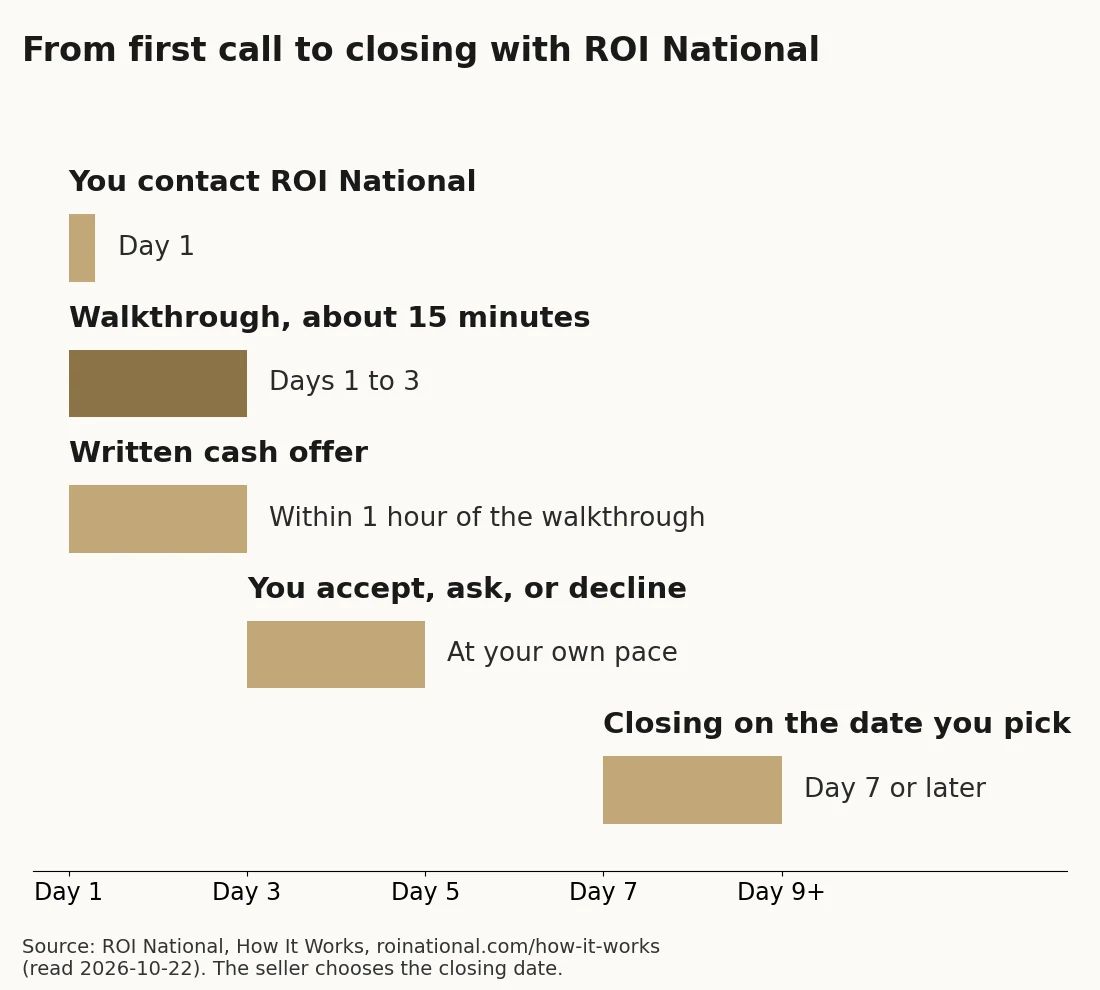
For what can stretch or shorten that calendar, see how long closing takes with a cash buyer.
Special Situations: Damaged Homes, Moving Up, and Hard Deadlines
Homes with serious condition problems
If your house has structural, fire, or water damage, or has been flagged as unsafe, many buyers cannot finance it or will not take it on. A buyer who backed out after seeing the condition may never have been prepared for it. Our page on how we buy houses in any condition and our article on selling a condemned or unsafe property explain what changes when the buyer expects the repairs.
Sellers who are moving up
If this sale was paying for your next home, a collapse can threaten that purchase too. Our piece on selling your old house for cash when upgrading covers how to line up both sides.
Sellers with a hard deadline
Foreclosure, an estate that must settle, or a job move all shrink your margin for error. Tell every buyer your deadline up front and ask how they would meet it. If foreclosure is the deadline, our guide to stopping foreclosure in Pennsylvania explains your options.
How to Choose a Buyer Who Will Follow Through
- Proof of funds before you sign, not after.
- A reasonable earnest money deposit held by a title company, attorney, or broker.
- A named title company or closing attorney in the agreement.
- Clear terms on fees and repairs: who pays closing costs, and what happens if the inspection finds something.
- Short, dated contingency periods, so the buyer cannot keep an open exit.
- No pressure. A buyer you can trust gives you time to read, ask questions, and talk to an attorney.
A local buyer is easier to reach and to hold to their word. If you are in Northeast Philadelphia or Bucks County, see how we work with sellers in Frankford and Southampton.
About ROI National
Illustration.
ROI National is a cash home buyer serving Pennsylvania, New Jersey, and Delaware since 2015, from 1310 Industrial Blvd, Suite 103, Southampton, PA. The company holds a 5.0 rating across 54 Google reviews. Offers are written, arrive within 1 hour, and come with no obligation. Closing happens through a title company; sellers can suggest their own or use the one ROI works with, and ROI covers all closing costs, including title fees and transfer taxes. Payment is by cashier’s check or wire transfer. Our breakdown of closing costs on a cash offer in Pennsylvania shows what normally appears on the settlement statement. This guide is general information, not legal advice; a real estate attorney licensed in your state can review your agreement.
Did your buyer back out? Get a written cash offer with no obligation.
Frequently Asked Questions
Can a cash buyer legally back out of a signed contract?
It depends on the agreement. If the buyer cancels inside a contingency period, such as an inspection or title review window, they can usually leave and get the deposit back. If they cancel without a reason the agreement allows after those windows close, they may be in default. Have an attorney read your agreement.
Do I keep the earnest money if the cash buyer cancels?
Sometimes. The CFPB says earnest money is returned to the buyer when the contract ends for a permissible reason and may be paid to the seller when the buyer does not perform in good faith. Your agreement’s wording decides which applies.
Who holds the deposit while a dispute is settled?
The neutral party holding it. In Pennsylvania a broker must keep disputed money in escrow until the dispute is resolved. A title company or attorney will usually wait for written instructions from both sides.
Do I have to tell the next buyer why the last sale fell through?
Pennsylvania requires sellers to disclose known material defects on the property disclosure statement. If the last inspection revealed a defect, you now know about it. A buyer running out of money is different. Ask your attorney what applies to you.
How can I tell if a cash buyer is serious before I sign?
Ask for proof of funds, a named title company or closing attorney, and a reasonable deposit held by a neutral party. Watch for pressure to sign fast and for vague closing dates.
If your cash buyer backed out, or you want your next sale to hold together, contact ROI National or call (215) 278-9944. Tell us about the house and your timeline, and we will give you a written offer with no obligation.