
When you sell your house for cash, there is no bank, no appraisal, and no loan approval to wait on. So it is fair to ask how earnest money works with a cash buyer, and whether it still matters. It does. Earnest money is the buyer’s deposit that backs up the signed agreement, and in a cash sale it is one of the few things standing between you and a buyer who walks away. This guide explains what the deposit is, who should hold it, what happens to it at closing, and what happens to it if the sale falls apart.
If you are new to selling for cash, our step by step guide to how ROI National works shows the whole process from first call to closing day.
What Earnest Money Is
The Consumer Financial Protection Bureau defines earnest money as “a deposit a buyer pays to show good faith on a signed contract agreement to buy a home.” It says the deposit “is held by a seller or third party like a real estate agent or title company” (CFPB, mortgage key terms).
Three points follow from that definition:
- It is a deposit, not a fee. It is not money you earn on top of the price.
- It is tied to a signed agreement. A buyer who asks you for money, or who offers money, before anything is signed is not paying earnest money.
- Its job is to give the buyer something to lose if they back out without a reason the contract allows.
Does a Cash Buyer Still Put Down Earnest Money?
Usually, yes. A lender never required earnest money in the first place; the purchase agreement does. So the reason for it is the same in a cash sale: it shows the buyer is committed and gives you a remedy if they are not. The amount is not set by any law. It is whatever the buyer and seller write into the agreement, so read that line before you sign.
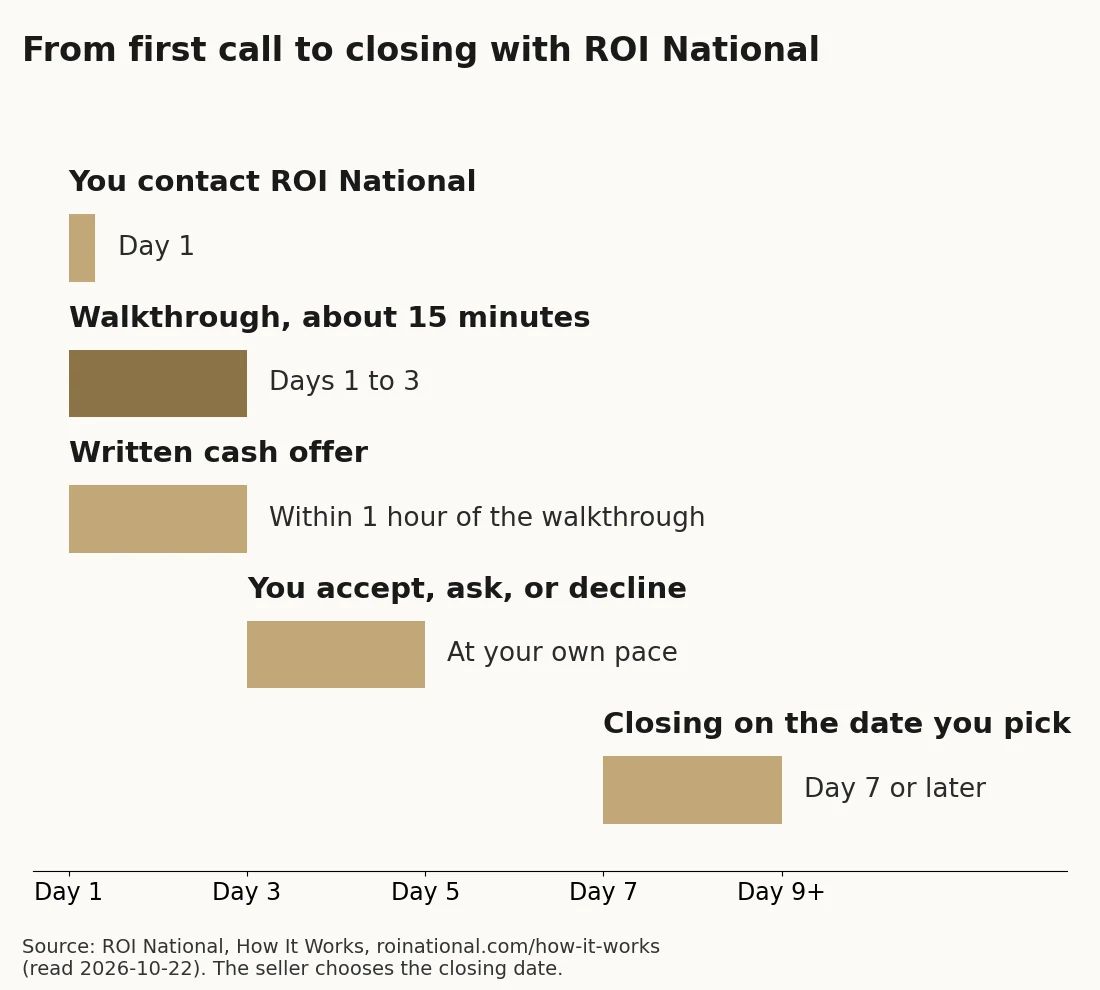
A cash sale also moves fast. ROI National lets the seller choose a closing date from as soon as 7 days to 60 days or longer, which means the deposit may only sit in escrow for a week or two. The chart below shows where the signed agreement and deposit fall on that calendar.
For what can stretch or shorten that calendar, see how long closing takes with a cash buyer.
Who Should Hold the Deposit
The safest place for earnest money is with a neutral third party: the title company or settlement attorney handling the closing, or a real estate broker’s escrow account. Not the buyer’s own account, and not cash passed across your kitchen table.
Pennsylvania escrow rules for brokers
In Pennsylvania, brokers who hold deposits follow State Real Estate Commission rules. A broker must put money into the escrow account “by the end of the next business day following its receipt” (49 Pa. Code 35.324). If the buyer and seller later disagree about who gets it, “the broker shall retain the money in escrow until the dispute is resolved” (49 Pa. Code 35.327). Those rules are why a neutral holder matters: neither side can quietly take the money.
When there is no broker
In a direct sale to a cash buyer there is often no broker, so ask which title company or attorney will hold the deposit and get that name in the agreement. ROI National closes through a title company, and sellers can suggest their own title company or use the one ROI works with.
What Happens to Earnest Money at Closing
The CFPB says that when the sale closes, the earnest money “may be applied to closing costs or the down payment.” In a cash sale there is no down payment, so the deposit is credited toward the purchase price. You still receive the full agreed price: part of it was simply paid early and held in escrow.
Check the settlement statement at closing. The deposit should appear as a credit to the buyer, and your proceeds should equal the agreed price minus anything the contract says you pay. With ROI National, the company states that it covers all closing costs, including title fees and transfer taxes, so the offer you accept is the amount you receive. Our breakdown of closing costs on a cash offer in Pennsylvania shows what is normally on that statement, and the seller closing cost calculator lets you run your own numbers.
What Happens If the Sale Falls Through
The CFPB puts it simply: “If the contract is terminated for a permissible reason, the earnest money is returned to the buyer,” and “If the buyer does not perform in good faith, the earnest money may be forfeited and paid out to the seller.”
If the buyer cancels under a contingency
“Permissible reason” means a reason written into your agreement. In a cash sale there is no mortgage contingency, but there can still be:
- An inspection or due diligence period, during which the buyer may cancel and get the deposit back.
- A title contingency, if the title search turns up a lien or ownership problem that cannot be cleared.
- Any other condition you agreed to, such as the buyer selling another property first.
If the buyer simply walks away
If the buyer simply changes their mind after those periods end, the agreement usually lets the seller keep the deposit. The exact wording controls, so read the default clause. If the title company or broker is holding the money and the two of you disagree, it stays in escrow until the dispute is settled.
Red Flags Around Earnest Money
- The buyer asks you for money. Earnest money flows from the buyer, never from the seller. A request for an upfront fee or “deposit” from you is a warning sign.
- No deposit at all, and no explanation. It removes the buyer’s cost of walking away.
- The buyer wants to hold the deposit themselves, or pay you directly instead of through the title company.
- Vague cancellation terms, such as an inspection period with no end date, which lets the buyer leave with the deposit at any time.
Our guide on how to spot a legitimate cash home buyer near you covers the other warning signs, and if you are holding more than one offer, see how to compare multiple cash offers on your house.
Questions to Ask About the Deposit Before You Sign
- How much is the earnest money, and when will it be deposited?
- Which title company, attorney, or broker will hold it?
- Which conditions let the buyer cancel and get it back, and when do those periods end?
- What happens to it if the buyer does not close on the agreed date?
- Where will it appear on the settlement statement?
Our checklist of the paperwork for a cash sale in Pennsylvania lists the documents you will see along the way. This guide is general information, not legal advice; a real estate attorney can review your specific agreement.
About ROI National
Illustration.
ROI National is a cash home buyer serving Pennsylvania, New Jersey, and Delaware since 2015, from 1310 Industrial Blvd, Suite 103, Southampton, PA. The company holds a 5.0 rating across 54 Google reviews. Offers are written, arrive within 1 hour of a walkthrough of about 15 minutes, and come with no obligation. Closing happens at a title company, usually takes 30 to 60 minutes, and pays out by cashier’s check or wire transfer. For sellers in the city, our Philadelphia quick home sale page explains how a fast sale is set up, and selling for cash in Bucks County covers the suburbs.
Have a cash offer and questions about the deposit?
Frequently Asked Questions
Do cash buyers put down earnest money?
Most do, because the purchase agreement, not a lender, calls for it. The deposit shows the buyer is committed and gives the seller a remedy if the buyer backs out without a reason the contract allows.
Who holds earnest money in a cash sale?
A neutral third party, usually the title company or attorney handling the closing, or a broker’s escrow account. Pennsylvania brokers must deposit it by the end of the next business day after receiving it.
Can I keep the earnest money if a cash buyer backs out?
Often, if the buyer backs out for a reason the agreement does not allow. If they cancel under a contingency, such as an inspection period, the deposit usually goes back to them. The wording of your agreement decides it.
How much earnest money is normal with a cash buyer?
No law sets an amount in Pennsylvania. It is whatever the buyer and seller agree to in writing, so ask for the amount and the deposit date before you sign.
What happens to earnest money at closing?
It is credited toward the purchase price. You still receive the full agreed price, because the deposit was part of what the buyer paid.
Weighing a cash offer and want a straight answer about the deposit or the contract? Contact ROI National or call (215) 278-9944.