
Selling a home gets harder when a judgment lien or unpaid homeowners association dues are attached to it. Both show up in the title search, and either one can stop a closing if nobody deals with it ahead of time. If you need to sell a house in Pennsylvania and you know, or suspect, there is a judgment against you or a balance owed to an HOA, this guide explains how each debt attaches to the property, what Pennsylvania law says about them, how they come out of your sale proceeds, and what your options are.
If time matters more than squeezing out the top listing price, our quick home sale process is built for sellers with title issues like these.
What Is a Judgment Lien, and How Does It Attach to a House?
A judgment lien starts with a lawsuit. When a court rules that you owe money, for example on a credit card, a medical bill, a personal loan, or a contractor’s invoice, and the judgment is entered in the county where you own property, it becomes a lien on your real estate in that county. Unlike a mortgage, you never agreed to it, and many homeowners do not learn it exists until they try to sell or refinance.
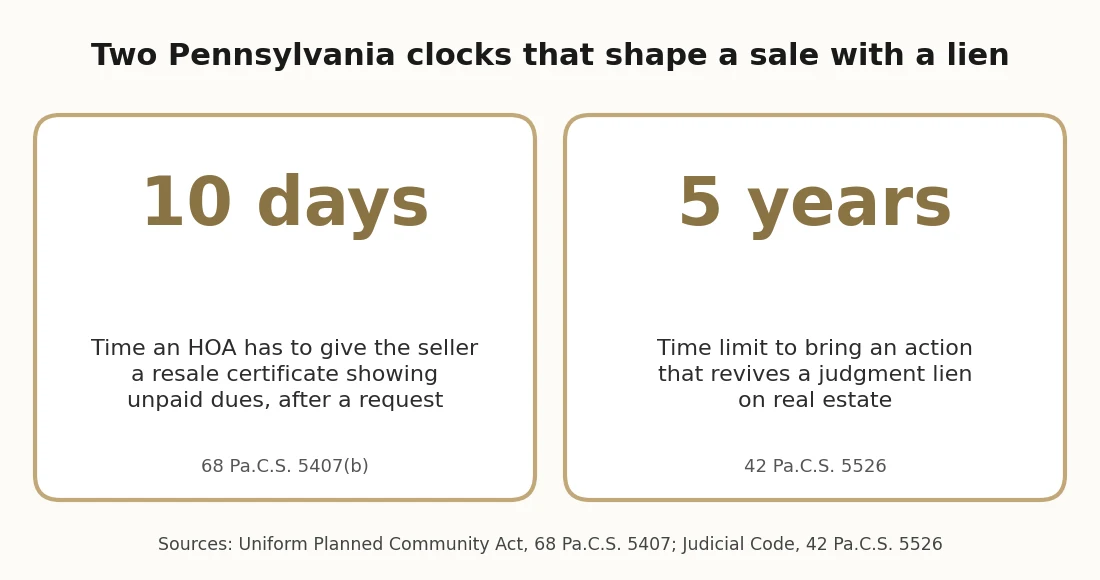
In Pennsylvania the lien does not last forever on its own. The Judicial Code sets five years as the time limit to bring an action reviving a judgment lien on real property (42 Pa.C.S. 5526). Creditors who want to keep their place in line file to revive it, so an old judgment can still be attached years later. Interest also keeps running, so the payoff today is rarely the payoff at closing.
How Do Unpaid HOA Dues Become a Lien?
In a Pennsylvania planned community, the HOA does not need a lawsuit. Under the Uniform Planned Community Act, the association has a lien on your home for any assessment or fine from the moment it becomes due, and recording the community’s declaration counts as the notice that perfects that lien (68 Pa.C.S. 5315). Late fees, interest, and collection costs can be added to the balance, and an association can enforce its lien much like a mortgage.
The resale certificate shows what you owe
When you sell a home in a planned community, you have to give the buyer a resale certificate from the association, and it lists the monthly assessment and any unpaid assessments currently due. The association must provide it within ten days after you ask, and the buyer is not liable for any unpaid assessment greater than the amount the certificate states (68 Pa.C.S. 5407). That is why title companies insist the HOA balance is settled at closing: the certificate fixes the number, and the seller’s proceeds pay it.
Why Liens Surface During the Closing Process
Once you accept an offer, the title company searches the county records for everything recorded against the property: mortgages, judgment liens, HOA liens, tax claims, and municipal liens. Anything it finds must be paid, released, or otherwise cleared before clean title can pass to the buyer. If a buyer is financing, the lender will not fund until the title is clear, because it will not lend against a property with a competing claim. An undisclosed lien that turns up late is one of the most common reasons closings slip or fall apart. Our guide on how long closing takes with a cash buyer shows where that time goes.
How Liens Change Your Sale Price and Timeline
Your net proceeds
Every lien is paid from your proceeds at closing, along with your mortgage payoff, transfer tax share, and other closing costs. If what you owe comes close to the sale price, you may walk away with little, or need to bring money to the table. Our breakdown of closing costs on a cash offer in Pennsylvania shows the other line items that come out of the same pot.
Your timeline
A listed sale already takes weeks for showings, negotiation, inspections, and the buyer’s loan. Getting a payoff letter from a judgment creditor’s attorney or a resale certificate from an HOA adds more steps, and each one can stall if the other side is slow to answer. For a seller facing a job move, a divorce, or growing debt, those extra weeks matter.
Your Options for Selling With a Judgment Lien or HOA Debt
- Pay the lien or HOA balance before listing, if you have the money, so the title is clear from day one.
- Negotiate a payoff with the creditor or association. Creditors holding older judgments sometimes accept less than the full balance to get paid now.
- Pay the lien from the sale proceeds at closing, which takes early coordination between the title company and the lienholder.
- Sell to a buyer who handles title issues as part of the purchase, which removes the lender and shortens the back and forth.
Whichever route you pick, get a written, current payoff first, including the per diem interest on a judgment, so the number at closing is not a surprise. If tax debt is part of the picture too, our guides on delinquent property taxes in Bucks County and settling IRS debt by selling your home cover those liens.
How a Cash Sale Can Simplify a Complicated Title
A cash home buyer does not need a lender’s approval, which removes one of the biggest sources of delay when a title has problems. The buyer and the title company can set up the lien and HOA payoffs as part of the closing instead of asking you to clear everything first. For a seller watching interest build on a judgment, or getting collection letters from an association, a shorter closing can make a real difference. You can see the documents involved in our guide to cash sale paperwork in Pennsylvania.
Steps to Take Before You Sell
- Order a lien search from a title company so you know exactly what is recorded against the property.
- Ask your HOA in writing for a resale certificate, which also tells you the current balance.
- Get a written payoff quote for any judgment, including daily interest.
- Talk to a real estate attorney if a lien amount is disputed or you think it was recorded in error.
With those numbers in hand you know what you will actually walk away with, and choosing between a listing and a direct sale gets easier. Our frequently asked questions page covers how a direct sale works, and our offer calculator gives a starting estimate.
Working With a Buyer Who Handles Liens and HOA Payoffs
ROI National has bought houses in the Philadelphia area since 2015, from its office at 1310 Industrial Blvd, Suite 103, in Southampton, Pennsylvania. When you sell to us, we work with the title company to request the resale certificate, collect payoff letters, and coordinate lien releases, so you do not have to manage each piece yourself. We are not a law firm and do not give legal advice. If a lien is disputed, a real estate attorney is the right person to call, and we are glad to keep the sale moving while that gets sorted out.
Frequently Asked Questions
Can I sell my house in Pennsylvania if there is a judgment lien on it?
Yes. The lien is usually paid from your sale proceeds at closing, or settled beforehand, so the buyer receives clear title.
How long does a judgment lien last in Pennsylvania?
The Judicial Code sets five years as the time limit to bring an action reviving a judgment lien on real estate. Creditors often revive liens to keep them attached, so do not assume an old judgment has dropped off without a title search.
Will unpaid HOA dues come out of my sale proceeds?
Yes. The association’s resale certificate lists the unpaid balance, and the title company pays it from your proceeds at closing. The buyer is not liable for more than the certificate shows.
How fast does an HOA have to give me a resale certificate?
Under the Uniform Planned Community Act, within ten days after you request it.
Is a cash buyer a good option if my house has liens?
It can be. A cash sale has no lender waiting on clear title, and the payoffs can be handled through the closing, which often shortens the timeline.
If a judgment lien or HOA balance is standing between you and a sale, reach out to ROI National to talk through your situation and your options.